


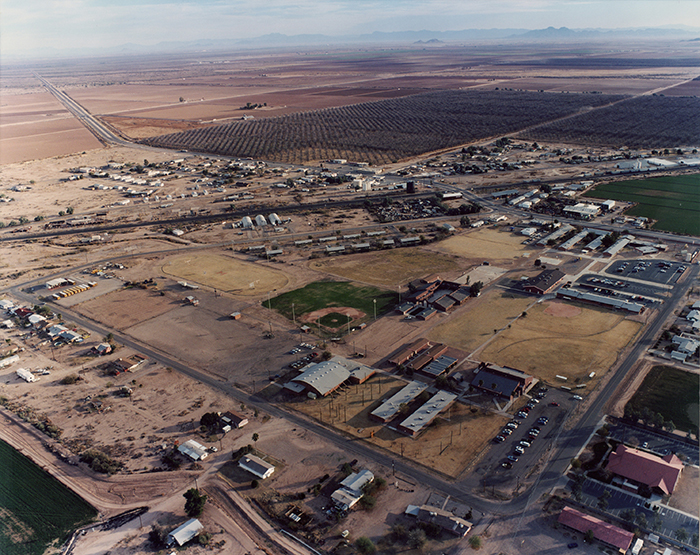
This data comes from the Arizona Commerce Authority’s community profiles for Maricopa, which capture snapshots of the city’s population, economic base, employers and civic indicators at different points in time. We used the 1998 profile to represent Maricopa before incorporation, and the most recent profile available for today’s snapshot, then placed them side by side.
1998
Before the boom
In the late 1990s, Maricopa was an unincorporated community shaped by agriculture, the railroad and a small but concentrated employment base. State Route 347 had only been established one year prior.
Population
8,451
Government
Unincorporated
Pinal County Board of Supervisors
Pinal County Sheriff’s Office
Maricopa Volunteer Fire Department
School enrollment
1,085 students
Maricopa Unified School District

Who worked in Maricopa
In the late 1990s, Maricopa’s economy was small enough that individual employers carried outsized importance. The Arizona Commerce Authority profile identified Harrah’s Ak-Chin Casino and Mobile Mini as the community’s two largest employers. Harrah’s employed roughly 700 people. Mobile Mini employed about 70 people, a significant share of the local workforce at the time.
What counted as ‘attractions’ then
The 1998 profile reflects a community with few local destinations of its own. Attractions listed included the Francisco Grande Resort in Casa Grande, along with activities such as clogging exhibitions, cotton gin tours and regional events like the Stanfield Friendship Days Parade. Maricopa Stagecoach Days appeared as an annual event at the time, and the Maricopa Agricultural Center Bar-B-Que was still active.
Services and infrastructure
Medical
No hospital in Maricopa; nearest in Casa Grande
Higher education
Closest Central Arizona College campus located 35 miles east of Maricopa
Financial institutions
No banks located in Maricopa
Utilities and communications
Electrical service through APS
Local water districts listed, but no unified regional water provider
Telephone service through U.S. West Communications

2026
Built fast
After incorporating in 2003, Maricopa became the fastest-growing city in Arizona, transforming from a small agricultural community into the state’s 17th-largest city within a single generation.
Population
81,103
Government
Maricopa City Council
Maricopa Police Department
Maricopa Fire and Medical Department
Civilian labor force
36,115
Who works in Maricopa now
The employer landscape changed completely. Mobile Mini, once Maricopa’s largest private employer, laid off roughly 90% of its workforce in 2008 and no longer anchors the local economy. Today, the Maricopa Unified School District is the city’s largest employer, with approximately 1,200 employees, reflecting a city workforce centered on education, healthcare, retail and professional services.
What replaced the old ‘attractions’
Local identity shifted inward. Maricopa now has two golf courses and city-owned recreation facilities at Pacana Park and Copper Sky, rather than relying on regional destinations. Maricopa Stagecoach Days, which dates back to 1959, returned last fall for the first time since 2017. Clogging exhibitions, cotton gin tours, the Stanfield Friendship Days Parade and the Maricopa Agricultural Center Bar-B-Que no longer exist. Today, the city’s marquee event is the Wild West Music Fest, a younger tradition that turns 3 this spring.
Services and infrastructure
Medical
First hospital in operation
Second hospital approved in 2025
Higher education
Central Arizona College campus located in Maricopa
Financial institutions
Eight banks operating in Maricopa
Utilities and communications
Electrical District No. 3
Global Water Resources
Cox
Orbitel Communications









One Response
“Blah blah blah some bullshit about Californians and bitching about apartments blah blah blah”