


Editor’s note: Julia Cox is a big fan of InMaricopa magazine, and she writes to us from Senita. She’s been penning a series of pet-related columns since June 2024.

To the editor,
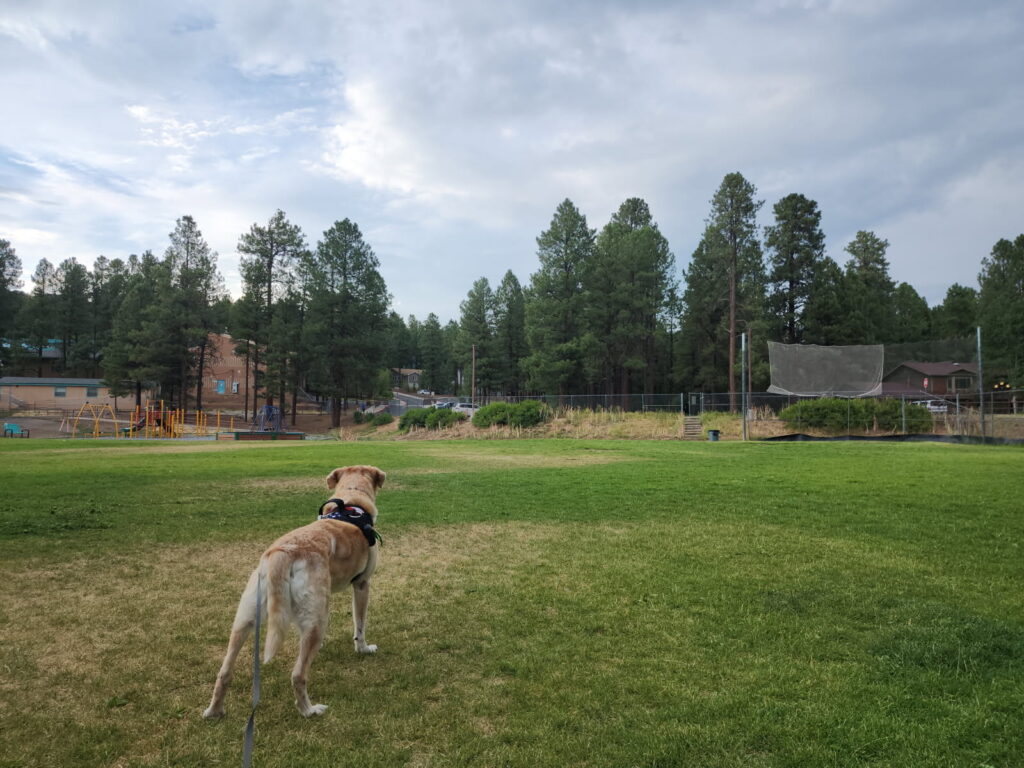
He’s a good boy; this golden retriever–yellow lab mix, heavy on the former, questionable on the latter — an all-American dog right down to the oversized slippers he triumphantly carries in his mouth. His name is Cooper, but he will answer to Mr. Long and Tall, or simply “Sir.”
Other descriptions such as loving, loyal and hungry come to mind when describing our boy — a dedicated foodie who knows what time it is, right down to the second. Of course, there’s no such thing as “Dinner O’clock” or “Bark-fast,” but we don’t correct him on the finer points. That would be discouraging.
I came into Cooper’s life late, but not too late. The same holds true for my relationship with Cooper’s human dad; a prime example of love in the 60s (the age, not the decade).
Mike is a widower who lost his wife to cancer several years ago. Because she was relatively young at the time, doctors did what they could to slow the disease but couldn’t offer much hope for a cure.
It was a difficult time for the family, most of them traveling back and forth from other states to help as long as they were able. Through the final year of chemo, and the empty days and nights of grief that followed, Cooper was constantly at Mike’s side. When his truck pulled into the driveway, and headlights lit up the walls inside the quiet home, he knew someone was waiting at the front door and the house was not as empty or as dark.
Mike and I met at a class he was teaching. Although neither of us had planned to marry again, our relationship grew and deepened. When he wanted to bring his large, tan companion to my house to meet my dogs, I knew we were heading toward something special.
Watchful for any problems that might arise, my first observation was the dogs were all the same shade of beige. My second was that Jack, my outspoken Chihuahua, was going to be Cooper’s lunch. To my relief (and amusement), a pecking order was quickly established, and it wasn’t 75-pound Cooper or my own large lab mix, Poppy, who became Head Dog, but the little guy with a gap between his front teeth.
The trio soon fell into a comfortable routine. They ate together; they went outside together, each with his or her own interests; and they all trooped back in together. With Cooper, though, it started becoming a little more often than it used to be.
Mike, now my husband, fought the changes he was seeing in his 11-year-old dog. Frequent urination progressed to leaking, but there didn’t seem to be a pattern to it. Because urinary incontinence can be symptomatic of underlying diseases or conditions—including UTIs, hormonal imbalances, tumors, diabetes, and nerve problems—Cooper’s veterinarian ordered tests.
When the results came in, all were negative.
Was that a relief? Yes and no. Mostly, we were perplexed. We knew something was wrong — they just hadn’t found it yet.
More money was spent. Medications were tried, stopped and adjusted. Yet there was no long-lasting improvement — no end to the cleanups — and no answer to the question: What do you do with an incontinent dog with no other health issues — who, through no fault of his own, has begun to pee inside the house?
When your dog can’t control his bladder, there is no perfect treatment. He has reached a place — a limbo, if you will — where quality of life becomes the issue, and not necessarily his. As time goes on, even your vet may gently begin to counsel you on final options for your almost-human companion who is simply old.
“But he eats and drinks with gusto!” you say. “He rolls in the grass and runs in the park!” What you don’t say is the thing that might bring tears to your eyes: He’s my friend.
In a study by Veterinary Information Network to evaluate the impact of urinary incontinence on quality of life, 2 in 3 surveyed dog owners were worried and/or stressed about their dog’s incontinence, and 47% thought their dogs were bothered by it. As a direct consequence, 8% of owners considered euthanasia for their dogs.
With an often-cited vet-assisted death rate of 85% compared to “natural death,” this can be a sobering issue.
For Mike and me, it took months of seeking a cause and a cure and not finding it, before we made a decision we could live with. But first we had to accept one thing: Not everything is fixable. And when you have a happy dog with no other issues — a dog who loves life as much as Cooper does — we have to be the ones to learn new tricks.
We now let Mr. Long and Tall outside as often and as long as possible during the day, temperature permitting. We don’t limit his water consumption; however, the bowl is taken up an hour before bedtime. One of us takes him out during the night, and indoors he wears a diaper at all times.
On that last point I have a confession to make: I think we had a harder time with the idea of subjecting our boy to this “indignity” than Cooper had with wearing one. Dogs don’t get embarrassed. People do.
Today’s washable, reusable diapers designed just for canines are a game-changer. They stay snug with Velcro, have elastic sides and can hold an astonishing volume if we’re gone too long.
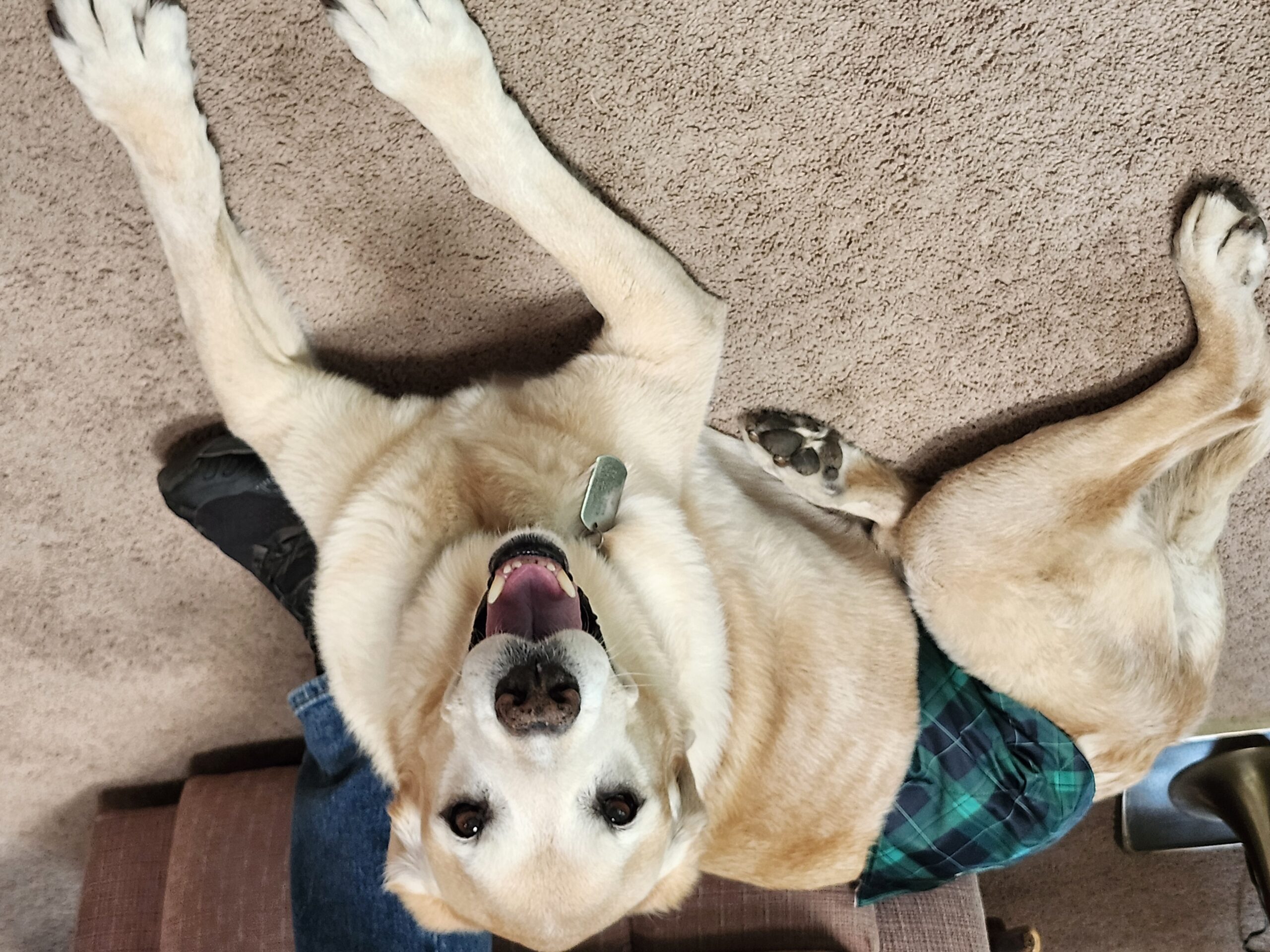
We call it Cooper’s cummerbund, and they’re available in a variety of colors and patterns. With his winning smile, he is the picture of health and looks quite dashing in a Scottish tartan of green and black.
Things aren’t perfect around here, but they’re okay — and “okay” is fine with us because we’ve learned to cope and adjust, knowing it won’t be forever. In return, we get to enjoy this good and loyal boy who’s given us so much, for a little bit longer.
Today, Jack is still the ringleader of the pack and sometimes they get on each other’s nerves, but at the end of the day, there are three bowls in a row: small, medium and large, and three wagging tails in front of them.