
I struggle each growing season to find better ways to keep my tomato plants healthy while fighting much-too-early Arizona heat.
I find regularly pruning your tomato plants throughout the growing season can achieve healthier plants, yield more fruit and enjoy a larger harvest. This means you’ll have an abundance of tomatoes that might not have been possible otherwise. There are three reasons pruning tomato plants is essential for a bountiful and healthy crop.
First, leaves and branches that touch the ground are prone to disease and pest infestations. Removing these low-hanging branches reduces the risk of such problems spreading to the rest of the plant. Once planted, clear all leaves and branches off the main stem 4 inches from the ground.
Second, a tomato plant with dense foliage tends to trap moisture and limit airflow, creating an ideal environment for diseases to thrive and spread. Pruning helps open the plant, allowing air to circulate more freely and reducing the likelihood of disease transmission. It also helps prevent the plant from becoming too heavy and sagging.
Last, as the growing season winds down, it’s beneficial for the plant to concentrate its energy on fruit development rather than new leaf growth. By pruning the new growth at the top of the plant, you signal it to focus on ripening its fruit. This way, the plant prioritizes enlarging and maturing tomatoes over getting taller.
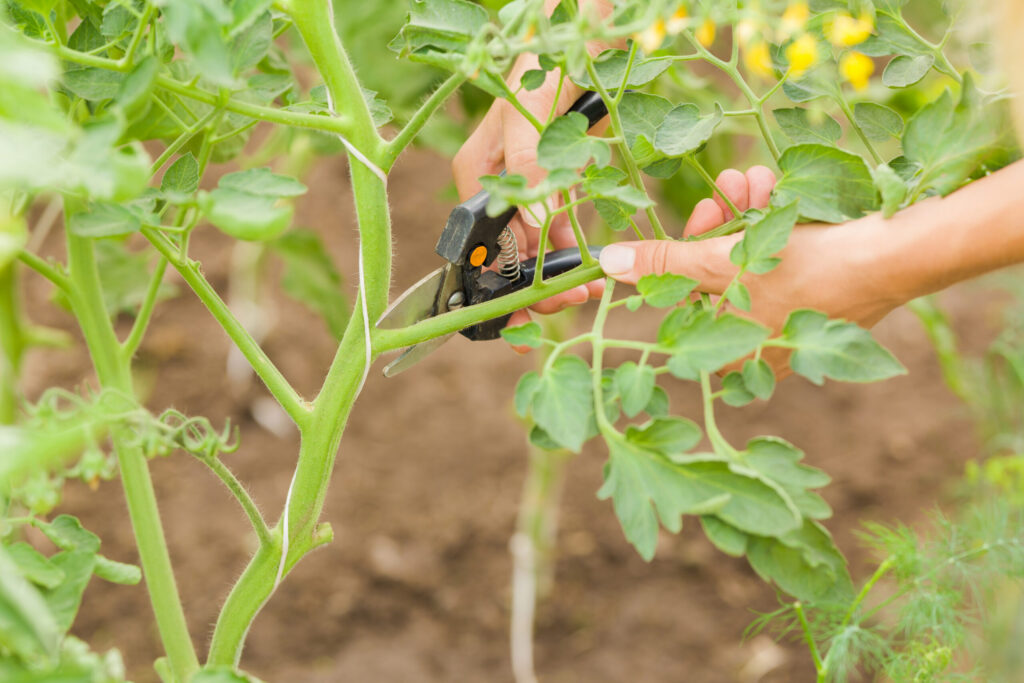
You’ll need a sharp pair of pruning shears to prune tomato plants effectively. Here’s what to focus on when pruning:
- Remove unproductive branches. Start by identifying branches with leaves but no fruit, especially those turning yellow or brown or showing signs of disease.
- Prune mindfully. Prune branches that are higher up and not bearing fruit to improve air circulation and light penetration. You might notice two branches at a point on the plant, one bearing fruit and another just below it with only leaves. The lower, leaf-only branches can be trimmed to prevent overcrowding. However, only remove one-third to half of these to avoid stressing the plant, which could divert its energy towards leaf production.
- Eliminate suckers. Suckers are branches that sprout from the base of the plant around the main stem, diverting energy from the main plant. Cut these as low as possible to focus the plant’s energy on fruit production.
Toward the end of the growing season, prune any green branches that are growing straight up and are relatively new.
Don’t rush to prune your tomato plants as soon as they start growing. It’s better to wait until they’re about one-third to halfway through the growing season. Look for signs like low-hanging branches beginning to yellow — this indicates your plants are ready for pruning. When your tomato plant starts to look full or its branches spill out of its support cage or stake, it’s a good time to thin it out.
Good luck and great growing!
Al Brandenburg is a Pinal County Master Gardener.