

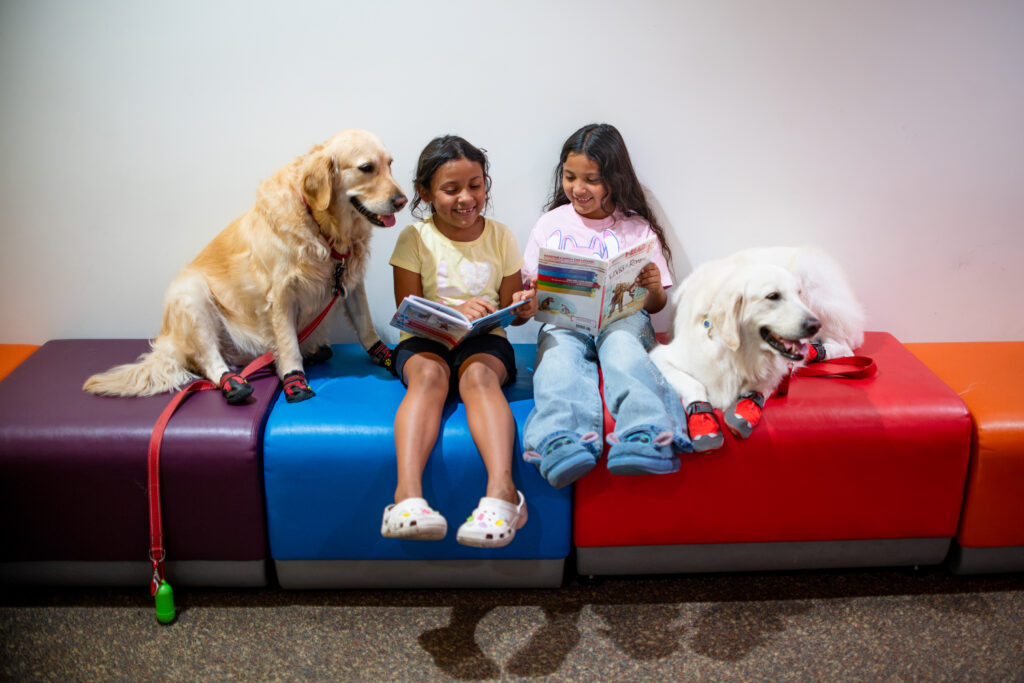
If you ask 8-year-old twins Perla and Victoria Ruiz Luna, the best part about reading at the library are the fluffy dogs they get to cuddle with.
It was the twins’ first time at Tales & Tails, a program at the Maricopa Library and Cultural Center that combines two favorite pastimes — reading and petting cute dogs — and they were ready, dog-themed books in hand.
“They love dogs and I think it will help them read better,” said their mother, also named Perla Ruiz Luna.
They were all smiles when their 15-minute session ended. Immediately after them, 7-year-old Violet Crawford filed in to have her turn reading to the therapy dogs.
“She hasn’t been a strong reader until this year; now she just feels more confident,” said her mother, Heidi Crawford. “She’s reading better after a couple of months.”
Crawford isn’t alone in thinking this. While research is still limited, a 2023 study published in the “European Journal of Special Needs Education” offered some encouraging evidence.
Struggling readers reading to dogs for 30 minutes twice a week showed greater gains in two standardized reading tests compared to those who participated in a similar reading program without dogs. Researchers also noted children spent more time on task and showed more positive emotions compared to children reading without dogs.
The benefits of programs like Tales & Tails may go beyond reading skills. For therapy dogs Honey and Hope, their job is less about teaching children to read and more about creating a calm, encouraging audience.
“The kids don’t judge and the dogs don’t judge the kids,” said Honey’s handler, Marykay Griffin, who lives in Maricopa Meadows. “And the dogs don’t care if they even read the words; they can make the story up as they go.”
Mother-daughter working duo
Griffin and her friend, Sheila Healy, have had their therapy dogs for about two years. They also happen to be a mother-daughter duo: Honey is 4 years old and is the mother of 2-year-old Hope.
Healey, a Homestead resident, thought Hope would be the perfect therapy dog due to her calm temperament and being a fast learner. She put her in training right away and Honey followed.
The mother-daughter duo has been working since February 2025.
“When they see each other, they’re all kisses, but then they buckle down and work,” Griffin added.
In addition to the reading sessions on Wednesday afternoons, the pair also work at Exceptional Community Hospital twice a week to greet patients, bring cheer and, once again, create a calm environment.
Research shows the calming effect has proven benefits. A 2019 clinical trial showed just 15 minutes of dog exposure was associated with “significantly lower anxiety” in emergency department patients compared to those who received usual care.
That’s something Dr. Brad Green, medical director of Exceptional Community Hospital, said he appreciates about Hope and Honey visiting the hospital.
“There’s sometimes long waits in the emergency room or when you’ve been admitted to the hospital for a couple of days,” he said. “Suddenly these two adorable dogs come in with their great owners, and it just perks the patients up.”
How to make a therapy dog
Both dogs had to go through rigorous therapy training before they were certified. They still undergo regular training to reinforce what they’ve learned.
That includes knowing commands like “sit,” “stay,” “paws up.” They are trained to wait at doors and stay in a sit position even when Griffin or Healy walk away until they hear the command “come.”
The dogs work with Chandler-based trainer Pam Beasley, who enforces positive training methods in public spaces by exposing them to a variety of scenarios, from different noises to being pet in different ways by different people.
“It emulates situations they would be in once they’re certified,” Beasley said.
The dogs were certified through the Alliance of Therapy Dogs following a three-day test where the dogs are expected to perform well in multiple public scenarios.
“There are great benefits. They help with healing, with suicide prevention, with depression.” Beasley said.
While Hope and Honey stick to the library and hospital, other therapy dogs are often paired with high stress agencies like police agencies, fire departments and morgues. Others work with senior and special needs communities.
“Everyone can benefit from therapy dogs,” Beasley said.
Griffin agreed.
“All we do is make people happy,” she said.
Good dogs, different jobs
Service dogs, therapy dogs, emotional support animals. Is there a difference? According to the American Kennel Club, yes.
Service dogs are individually trained to perform tasks directly related to an individual’s disability. They are the most extensively trained and have legally protected public access under the Americans with Disabilities Act.
Therapy dogs provide comfort in places such as medical facilities, libraries, schools and disaster scenes. Their handlers often volunteer and the dogs undergo training in behavior and obedience. Some programs require third-party certification.
Emotional support animals provide emotional support, well-being or companionship. They are not considered service dogs under the ADA and don’t have the same public access rights. They generally can go wherever pets are allowed and have certain protections under the Fair Housing Act.
This story first appeared in the October issue of InMaricopa.




![Councilmember Bob Marsh wears a large voting button during a ribbon cutting ceremony on Oct. 10, 2026. [Monica D. Spencer]](https://inmaricopa.com/wp-content/uploads/2026/10/20261010-spencer-bob-marsh-300x200.jpg)








![Councilmember Bob Marsh wears a large voting button during a ribbon cutting ceremony on Oct. 10, 2026. [Monica D. Spencer]](https://inmaricopa.com/wp-content/uploads/2026/10/20261010-spencer-bob-marsh-150x150.jpg)