

The front steps of the single-wide trailer are littered with empty wine bottles, torn cat-food bags and a long-abandoned dog crate. The air slipping through the doorjamb smells of ammonia and something sweeter, gone bad.
From the neighboring lot, Desiree Remmie could hear faint cries inside; dogs and cats trapped without food or water in the summer heat.
“They sounded panicked and unrelenting,” she said.
An animal lover, Remmie called 911 and waited.
And waited.
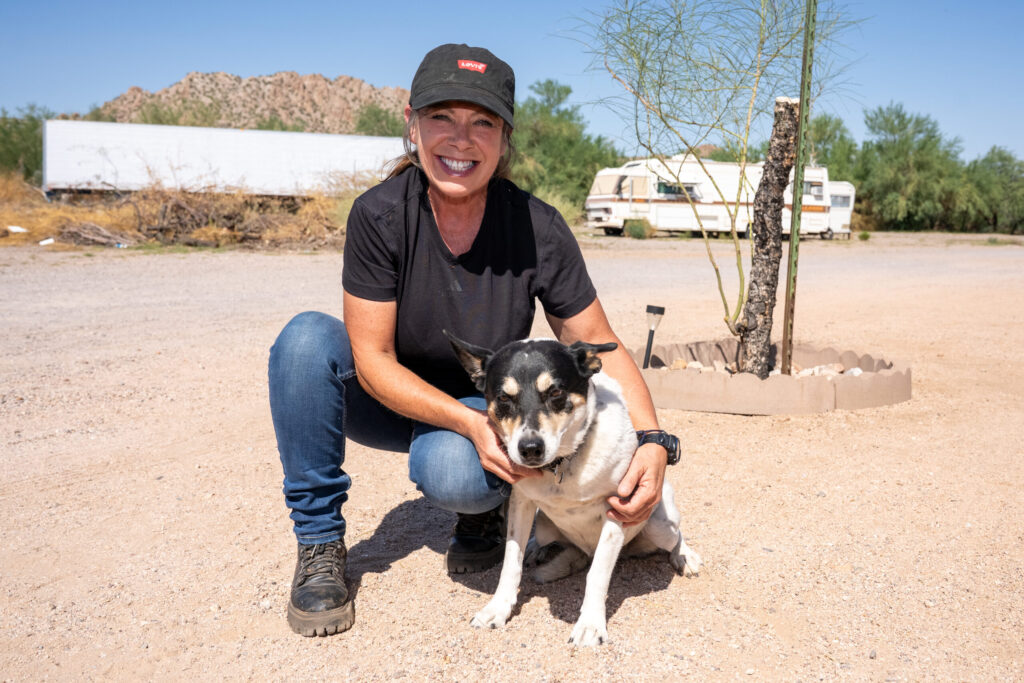
When help didn’t come quickly, she pulled on gloves, forced open an unlocked side door and freed a small dog too weak to walk. She rushed it to an emergency veterinarian. It died a short time later, likely from heat exposure.
That day has stayed with her.
“They were just left,” she said.
The trailer’s owners, an elderly couple, had been hospitalized and later moved into assisted living. The pets were left behind.

Inside the abandoned home
The path to the unlocked door wound through thorny brush and under low branches pressed against the trailer, now sunken into the desert floor. Much of the trash had been tied off in black bags, and a cleanup appeared underway. Inside, piles of rotting cat food and debris covered the floor. Through a curtained window, a cat watched silently, still and curious.
“There are cages inside and stuff stuck to the floor,” described Remmie, 61. “The smell is horrible.”
She said the occupants left behind multiple cats and at least two dogs. A relative came but did not take responsibility. The property owner called the authorities.
Pinal County records show no recent calls for service to the State Route 84 address at Stanfield’s Saguaro-One RV Park. Officials offered a different account of how such cases are handled.
“If these cats were free-roaming and not confined to the trailer, they are considered community cats under Arizona law,” said Katrina Rodriguez, deputy director of Pinal County Animal Care and Control. “They’re legally allowed to roam. We spay or neuter them and return them to where they were found.”
Rodriguez said abandoned animals, those confined or left without care, can be removed, but truly feral or outdoor cats cannot.
“We’re required to intake stray dogs,” she said. “Cats are different. We do take them in, but there’s a stray-cat fee.”
She added that residents sometimes receive wrong information because “they’re not talking to Animal Control directly, they’re talking to the county call center. People should ask to speak to Animal Control.”
When a sheriff’s deputy arrived, Remmie said she begged them to look inside. The deputy declined, saying he had “seen places like this,” and allegedly advised her to “just let the cats out.”
A Pinal County Sheriff’s Office spokesperson could not confirm the account.
“I don’t think that’s safe,” Remmie said. “They’re pets. They can’t fend for themselves out here.”
Another neighbor, who asked not to be named, said she also found animals trapped inside weeks earlier. “County officials told me the same thing,” she said. “But they were pets, not wild animals.”
City, county roles blur in animal welfare cases
Within city limits, Maricopa’s one-man Animal Control division is the tasked with handling neglect and cruelty reports — but Officer Luke Ziccardi is only on duty Monday through Thursday. And regardless, many residents still dial 911, creating delays, duplicate dispatches and confusion over which agency has authority to enter a property or remove an animal.
County policy on community cats further complicates the picture. Under Pinal County’s charter, free-roaming cats may be sterilized and returned to the same block where they were found, even when that’s inside city neighborhoods.
As abandonment cases rise along the rural fringe, more strays are drifting into town, increasing bite risks, traffic hazards and wildlife conflicts, and adding new costs for the city unit responsible for trapping, transporting and holding animals until owners are reached or shelters can accept transfers.

Municipal spokesperson Monica Williams described the costs as “minimal,” adding the city handles “just two or three” Pinal County calls weekly.
“Currently, the City of Maricopa partners with Pinal County to shelter rescued and stray animals,” confirmed Williams. “Our collaboration with the county allows us to meet our community’s needs while keeping costs minimal.”
Rescuing pets and facing bureaucracy
Remmie said she took in a larger dog, a border collie mix, from the same trailer to give it water and food. The next day, men came to collect belongings and demanded the dog back. When she hesitated, she says a deputy warned her she could be arrested.
“I cut off a shock collar when I first got him,” she said. “He was so thirsty. So skinny. I was surprised he was alive.”
She turned him over to the county.
Remmie, who relocated from The Villages at Rancho El Dorado for a rural lifestyle, said some of the RV park’s residents who call for help are told there is no room and to “let their pet out the front door.”
“There are so many dogs in shelters that there isn’t enough room to house them all,” she said. “People need to understand that once they welcome a dog into their home, it’s a lifetime commitment.”
PCACC data shows in 2020, the county took in 3,287 animals from the public: 2,181 dogs and 1,106 cats.
Since then, intakes have remained steady at about 250 animals per month, mostly dogs. Despite overcrowding, officials tout a 96.5% live-release rate, meaning most animals are adopted, rescued or reunited with owners — but the county didn’t euthanize a single animal from 2018 to 2024.
Summer months bring spikes in intake and heat-related emergencies, stretching staff and resources. Reports of “community cats” have also increased since 2022, mirroring what residents describe as a rise in strays in rural Maricopa.
Remmie claims when she followed up about the border collie’s welfare, PCACC told her it was “none of my business.”
“Maybe they didn’t even write a report,” she said. “It feels like sweeping it under the rug.”
Rodriguez said the policy is reports are generated whenever deputies respond to neglect calls and the county’s animal care team can be reached through its online surrender system. However, she acknowledged the possibility that the call in question may have mistakenly not been logged.
Watching over strays
Nights in the desert south of Maricopa bring loose packs of dogs that nose at trash cans and take shade under mesquite. Remmie keeps metal bowls by her door, unwilling to let another stray suffer, she says.
By mid-October, the trailer at Saguaro-One had been cleared of most debris. But for Remmie, the memory lingers, a reminder of how thin the line can be between a pet, a stray and something the system no longer sees.
If you must surrender a pet, do it properly.
https://www.pinal.gov/484/Surrendering-a-Pet
Who to call for animal issues
County officials urge residents to report neglect directly to PCACC, not through police dispatchers, to ensure cases are logged and investigated.
City of Maricopa
📞 520-316-6812 (Mon–Thu)
📞 520-568-3673 (Fri–Sun)
Pinal County
📞 520-509-3555














One Response
I have video evidence and court documents showing the extreme corruption within Pinal County Animal Control, but I cannot find anyone in county government who cares. The PREVIOUS county attorney had agreed that he would prosecute, but he needed the sheriff’s office to make arrests, which they won’t. (That sheriff is a personal friend of the dog owner.) The current county attorney had defended the people I tried to sue back before he was our prosecutor. So he’s not interested.
— The core issue is that they will commit felonies to protect their personal friends. Deputy director Rodriguez stood right in front of me as she told a neighbor, “Don’t worry I’ll make sure (he) can’t do anything.” Examples include DESTROYING and CHANGING EVIDENCE and VICTIM’S SUBMISSIONS, AS WELL AS THE ANIMAL CONTROL OFFICER’S REPORTS, CITING LAWS THAT DON’T EXIST, and blaming a dog attack victim because he ATTEMPTED to protect himself BEFORE THE DOG HAD BIT HIM. (thus the dog had to bite him in self-defense.) Later, when a dog stuck its head through a fence gap to bite a neighbor, on the phone, Animal Control said the dog was on two properties at the time, and their computers couldn’t handle such a thing, so they couldn’t file a report. LATER, with the same case, they said there is no law against a dog biting someone while on its owner’s property. Yet during the same month, they charged another neighbor for exactly that.
— I have previously written InMaricopa about this–no response. Why is this regarded as “clever” instead of a “crime”?????
— Perhaps I need to make a “Leave a Reply” campaign to let the public know.