

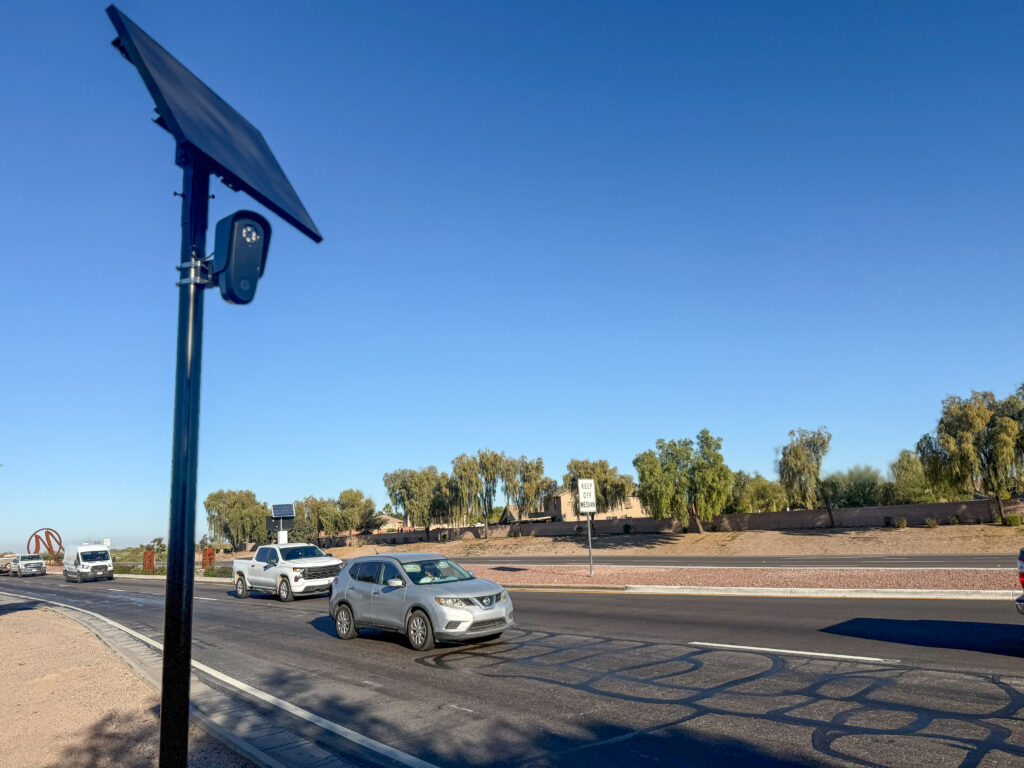
If you’re not looking for them, they’re easy to miss.
They sit high above the entrances and exits to nearly every neighborhood, and to the city itself. Small, nondescript black boxes point down at passing traffic.
Over the past year, Maricopa has expanded that camera network by nearly 30%, according to the city, deepening its reliance on automated license plate readers — or ALPRs — as a core policing tool.
Police leaders say the cameras have helped recover stolen vehicles, locate missing people and speed up investigations that once stalled on vague vehicle descriptions. Civil liberties advocates, meanwhile, warn the same technology creates a permanent record of innocent people’s movements, raising concerns about privacy, oversight and misuse.
Maricopa’s trajectory is clear.
While some Arizona cities have scaled back or canceled their use of license plate readers amid public debate, Maricopa has moved decisively in the opposite direction, expanding coverage even as a new city policy has narrowed what residents can learn about how the system is used.
What changed
Before the policy was adopted last fall, Maricopa residents had limited but meaningful ways to understand how the city’s license plate reader system was being used. When ALPR data helped identify a suspect or locate a vehicle, officers sometimes documented that role in police reports and probable-cause statements, offering a glimpse into how investigations unfolded.
That window narrowed in October, when the Maricopa City Council approved a new policy governing the release of ALPR information.
Under the policy, “all data and images gathered by an ALPR are not open to public review.” That includes records showing when officers search the Flock database and what prompted those searches.
Police Chief Mark Goodman said the change was not about secrecy, but security.
“We’re not trying to be closed,” he said. “However, it is important to maintain the integrity of criminal investigations.”
Goodman said the system has internal safeguards, including required case numbers for searches and supervisor audits showing who accessed the system and when. He also acknowledged misuse is possible and said it has happened.
In a previous Maricopa police case involving ALPRs, a department employee “colored outside the lines,” Goodman said, without elaborating. “We took appropriate action.”

Why police say the cameras matter
Supporters of license plate reader systems point to speed and specificity.
Before ALPRs, a burglary investigation might hinge on a witness description of “a green car” or “a vehicle with a sticker;” leads that often went nowhere. The cameras can identify vehicles even when plates are partially obscured and can alert officers when a car tied to a stolen-vehicle report, Amber Alert or felony investigation enters the city.
Across Arizona, police agencies have credited similar systems with stopping crimes in progress.
In Scottsdale, police said a license plate reader alert led officers to a stolen vehicle tied to a fugitive wanted in a New York murder case. Officers arrested the suspect in a Fashion Square Mall parking lot in 2024. Police later said the suspect admitted he intended to commit additional violent acts at the mall.
Scottsdale police have also described incidents in which real-time alerts warned officers a suspect was armed moments before a confrontation, information they said likely prevented officers from being ambushed.
Goodman said Maricopa police have relied on the system in similar ways, particularly in stolen-vehicle cases and time-sensitive alerts.
“If you’re a law-abiding Maricopa resident, you have absolutely nothing to worry about,” Goodman said, “and if you’re a criminal, we just have another tool.”
Why critics push back
The same technology praised by police has sparked intense backlash elsewhere in Arizona.
In Flagstaff, the city council voted unanimously in December to cancel its contract with Flock Safety after months of public concern about privacy and the scale of data collection. Local organizer Brendan Trachsel argued the cameras created a record of residents’ movements that would never be tied to crime. Flagstaff police cited the system’s role in locating a missing toddler and other cases, but the council ended the contract anyway.
Sedona followed a similar path, canceling its Flock agreement after residents raised concerns about surveillance and oversight.
In Tempe, residents and advocates with the ACLU of Arizona have pressed city leaders to reconsider the city’s use of Flock cameras, warning the system can be used to map daily routines, including visits to medical or religious locations. Tempe officials have said the cameras do not use facial recognition and automatically delete data after 30 days unless tied to an active investigation. The city has referred its contract to a data governance committee amid the broader controversy.
In Scottsdale, where police credit Flock alerts with arrests in multiple high-profile cases, critics have focused less on the outcomes than on the scope of the system behind them. Residents and activists told city leaders they were alarmed by how widely the cameras were deployed and how little public discussion preceded their installation.
At city council meetings last fall, critics questioned how dozens of cameras came online without a vote and warned license plate readers create a searchable history of residents’ movements, even when no crime has occurred. Several speakers argued success in individual cases does not answer who decides how broadly the system is used or how searches are audited.
Maricopa’s path
Under Arizona law, license plates displayed on public roadways are not considered private, and courts have consistently held there is no reasonable expectation of privacy in plate numbers.
At the same time, Arizona’s public-records statute allows agencies to withhold records if disclosure would interfere with an active investigation. How those principles apply to large-scale license plate reader systems, particularly when cities adopt policies that categorically bar public review of usage data, remains largely untested.
Such policies have not been tested in Arizona’s courts.
For now, Maricopa records show continued investment in the technology even as other cities in the state pause or reverse course. The result is a widening gap between how extensively the system is used and how much residents can see into its day-to-day operation.
There is little dispute that ALPRs have become a powerful — even life-saving — policing tool. What remains unsettled in Maricopa, like many other places, is whether internal guardrails alone are enough in a system that now quietly watches nearly every road in and out of the city.




![Walmart wants to bring drone delivery services to Maricopa. [Bryan Mordt, Wing]](https://inmaricopa.com/wp-content/uploads/2026/06/20260622-walmart-drones-300x169.jpg)







6 Responses
Most people in this country have willingly purchased and carried tracking devices every where they go for a long time…you know, your “cell phone.” There is no putting the genie back in the bottle…
Not only phones. Other tracking devices include newer cars, laptops, tablets, tv’s, smart watches, fitness trackers, ankle monitors, any app or website like amazon or Walmart, and anything else with a camera or online technology can and will be tracked, if the government takes notes from Europe and hire thought police.
TAB!!!
You’re still breathing!!!!
Excellent. Happy to hear it.
It doesn’t make it any better.
Failed to mention any department in the United States has access to another departments photos, a police department anywhere in any state can enter an Arizona plate and when that plate crosses a reader anyplace they are notified, it does matter if Maricopa has the gold standard for plate reader integrity, any of the other roughly 19,000 agencies using this system might not.
DAMN IT, GET RID OF FLOCK CAMERAS!!