

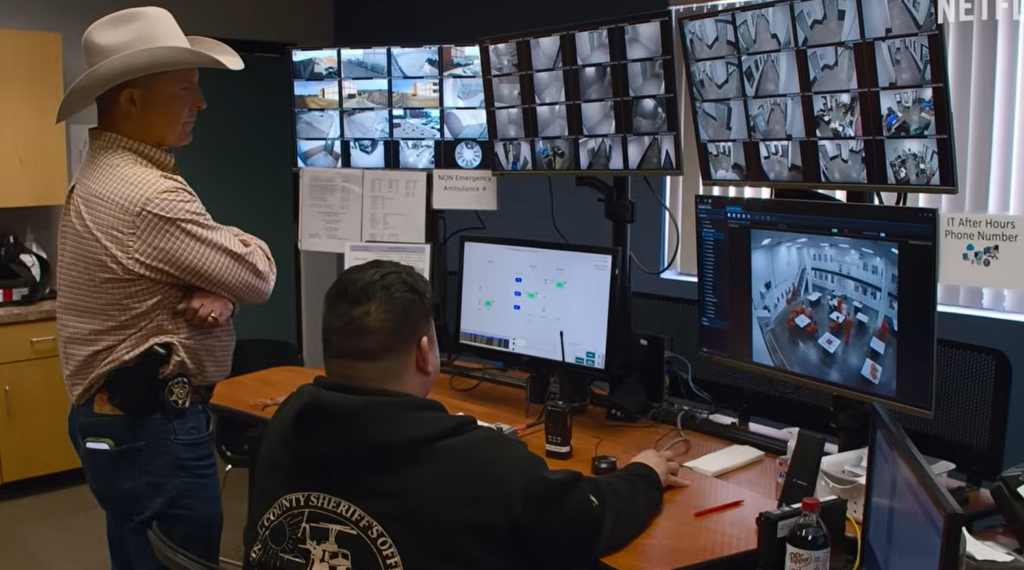
When Pinal County Sheriff Ross Teeple took on the job, he had a stack of things waiting for him from his predecessor, Mark Lamb.
Among them was an agreement with a Stamford, Conn., production company to invite a documentary crew into his jail.
“He came to me and said, ‘Ross, you came from the corrections world. Tell me about this,” Teeple told InMaricopa this morning, speaking of the former sheriff.
A year later, that work will be featured in a new season of a Netflix documentary series, placing the Pinal County Adult Detention Center under a national spotlight next month and chronicling a six-week experiment that gave inmates unprecedented control over daily life inside the jail.
All episodes of Unlocked: A Jail Experiment premieres Jan. 7. The second season of the reality show follows a pod of inmates whose cell doors were left unlocked for much of the day, allowing them to manage meals, cleaning and conflicts with limited staff involvement.
Cameras were placed around the pod to document the results.
Teeple said the concept was rooted in his years working in corrections and a belief that incarceration has changed little in decades.
“If you go into a prison today, they do it the exact same way they did when I started in 1996,” Teeple said. “We wanted to see if we could find some way to do it better.”
The experiment was authorized shortly after Teeple took office and involved extensive planning and security considerations, including the installation of additional cameras inside the jail pod.
According to the series trailer, inmates describe spending up to 23 hours a day locked in cells under traditional jail operations and say prolonged isolation fuels anxiety, tension and violence. Teeple appears in the trailer outlining the risk involved.
“If it works, it’s a breakthrough,” he says. “If it fails, we could be making things a lot worse.”
Teeple said there were moments during filming when the risks became very real.
“There were definitely times where I thought, ‘I think we’re going to have to shut this thing down,’” he said, declining to elaborate ahead of the show’s release.
Jail officials said participants were preselected and excluded inmates with known histories of violence toward staff. The pod included inmates charged with a wide range of offenses, reflecting what Teeple described as the reality of jail populations.
“This wasn’t a reward program,” he said. “This was about responsibility.”
Participants were not paid but were given free phone access to maintain contact with family, a step officials said helps counter isolation for inmates who cannot afford collect calls.
Teeple said the experiment emphasized practical life skills rather than incentives, requiring inmates to identify realistic needs they wanted help addressing.
“You have to come to us and say, ‘What do I actually need to make better choices?’” Teeple said. “Not something unrealistic, something that actually helps you function when you get out.”
Some of the practices tested during filming have already influenced jail operations, including expanded reentry programming and individualized goal-setting, said Teeple.
Critics of jail-based reality television have argued such programs turn incarceration into entertainment. Teeple said he understands the concern but defended the project as a serious attempt at reform.
“It’s easy to sit on the sidelines and throw insults,” he said. “It’s a lot harder to get into the arena and try to actually change a culture.”
He said the goal is long-term public safety over leniency.
“The average length of stay in my jail is 19 days,” Teeple said. “I have 19 days to try to change some behavior, so they don’t come back and so when they go back to your neighborhood or mine, they’re a better member of society.”
The eight-episode season was produced by Lucky 8 TV, which also produced the first season filmed in an Arkansas jail. All episodes will be released at once on Netflix, meant to binge. Teeple said he will be watching Jan. 7 next to his mom.
The series’ producers said the show was not initially designed as entertainment.
“Season one was really just an experiment,” Lucky 8 production staff told InMaricopa. “They had no idea how this was going to go or whether people would tune in to watch it.”
The show found an audience and a quick renewal.
Pinal County’s jail has previously appeared in reality television programming, but Teeple said he hopes this series sparks a broader conversation about how jails operate nationwide.
“At the end of the day,” he said, “this was an experiment we tried, we learned from, and that will make our jail safer for staff and inmates.”

![Members of Maricopa Little League girls 12U All-Star softball team celebrate their District 4 win on June 16, 2026. [Maricopa Little League]](https://inmaricopa.com/wp-content/uploads/2026/06/20260617-maricopa-little-league-1-300x225.jpg)






![Maricopa Police Chief Mark Goodman speaks to Maricopa City Council while presenting his department's annual report on April 7, 2026. [Monica D. Spencer]](https://inmaricopa.com/wp-content/uploads/2026/05/GOV-Crime-Stats-by-Monica-D-Spencer-300x200.jpg)

![Members of Maricopa Little League girls 12U All-Star softball team celebrate their District 4 win on June 16, 2026. [Maricopa Little League]](https://inmaricopa.com/wp-content/uploads/2026/06/20260617-maricopa-little-league-1-150x150.jpg)