
The new Performing Arts Center at Maricopa High School will not only be a hallmark for the school district, but an important asset for the entire community.
As the largest performance venue in the city, it will be used for school performances, city-sponsored events, community theater and church functions.
“We have already started to book private, public, community and school events,” said Aron Rausch, director of business services for Maricopa Unified School District. “This building will be very much used by the community. A performing arts building is often a focal point of a school district and a community. Our Performing Arts Center will certainly be all of that and is probably the most up-to-date technical building.”
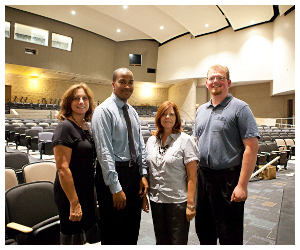
The performance hall will have modern designs to maximize acoustics. Each of the 750 seats will have a clear view of the stage, which will have more space than the typical high school auditorium. While most high school auditoriums have a 40-foot depth from front to back for their stage, the MHS facility will have an additional 20 feet. The depth becomes apparent once you step upon it and envision symphony putting on a grand-scale performance.
“The shape of the center will provide for great acoustics,” said Mark Snider, the project manager who supervised construction. “There is not a straight wall and seating is sloped. In addition, we installed a scalloped ceiling to enrich the experience and stage sound.”
Installing the special dome-like ceiling was one of the more complex aspects of the construction, Snider said. “In order to accomplish this feature, we actually constructed a 20-foot platform that stood 30 feet above the ground to allow for the construction team to install the scalloped forms on level ground, which resulted in a higher quality product.”
MHS Music Director Ivan Pour looks forward to testing the building’s acoustics and having a new stage to showcase his students’ talents.
“We now have the opportunity to put on professional performances and presentations,” Pour said. “While we always strive to have the best possible product with our programs, there are elements of the presentation we simply haven’t been able to pull off.
“We will now be able to consider lighting for dance routines. Our band, orchestra and choir students can set up days prior to a performance and we can tailor the music to the acoustics of the space so it sounds as good as it possibly can.”
***ADVERTISEMENT***Pour said the center will offer new opportunities never explored by the district.
“In the new space we can also record music performances,” Pour said. “We can have our band boosters provide refreshments in the lobby at concerts and we can professionally display the work of our visual artists in dedicated display cases.
“The drama program will be able to build sets and coordinate the elements of a performance in a space dedicated to them. We can go even more in depth with arts education than we could before.”
Carrie Vargas, founder of Maricopa Community Theatre, said she is impressed with the design of the hall.
“Even though it seats 750, it still has an intimate feel, if you can even imagine that,” she said. “The stage is very large, which will feel very liberating as a performer. The 25-foot wing space on each side of the stage allows for a lot of prep room for an actor, which is very cool.”
The 35,000-square-foot building on West Honeycutt Avenue was built in less than a year. It cost $8.2 million with an additional $4 million in furnishing and equipment, such as the padded seating and a state-of-the-art audio system and stage lighting.
Rausch said costs stayed within budget and called it a “great project for the money.”
“This project really has come together extremely well. We have to give credit for that to a very good architectural design and an extremely good general contractor,” Rausch said. “This project has been completed in about nine months, and that is a great deal of work in an extremely tight timeline.”
Snider agreed. “From the beginning, we’ve had a very collaborative team working closely with the architect and the owners. We’ve been able to maintain good communications keeping things on track.”
Snider, who works for McCarthy Construction, also credited Mother Nature. “We were fortunate to have good weather throughout the project, so no typical delays happened.”
The Performing Arts Center is the last capital improvement project of the $58 million bond package approved by voters in 2006. Other projects financed through the same bond include the bus barn and maintenance and operations facility.
“It is great to see the vision of the community come to life,” Superintendent Jeff Kleck said. “This should be a hallmark of the community for several years.”