


Affordable housing? Maricopa needs more of it.
At least that’s the recommendation economic analysts shared when they presented the Maricopa Housing Needs Assessment to the city council Tuesday.
Senior Economist Danny Court of Elliott D. Pollack & Company, a Scottsdale real estate consultant, told councilmembers that because the city is poised to continue growing its population over the next decade, it needs to consider adding more affordable housing options.
Why? He said residents are currently “overburdened” by the price of housing, a trend InMaricopa highlighted in its print edition last month.
“We still have a third of our residents that are overburdened by their housing costs,” Court said. “With the rapidly growing population, that’s only likely to worsen if we don’t keep up with the housing supply.”
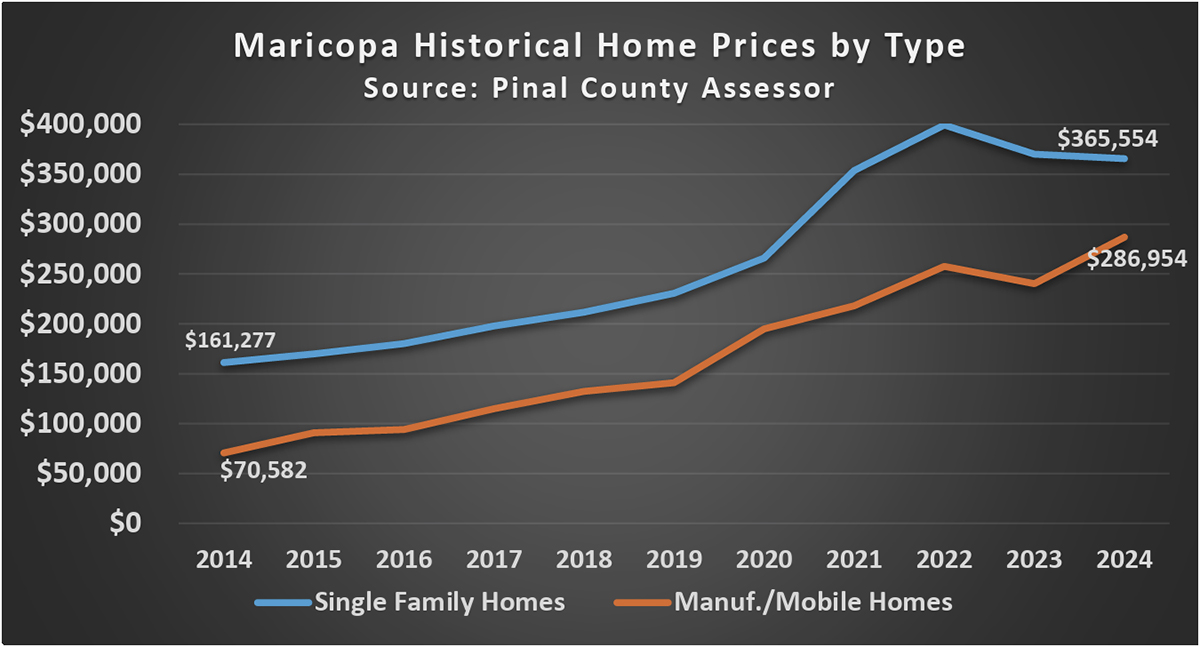
Since the pandemic, home prices have risen by nearly 60% but residents only saw a 20% increase in their paychecks.
That means 30% of Maricopa homeowners and nearly 70% of renters are spending significantly more of their paychecks to keep a roof over their heads, resulting in worrisome numbers of Maricopans being “severely rent overburdened.”
“This is a state and national issue we’re dealing with, and Maricopa is not immune to it,” Court said.
Ways to increase housing affordability
Court said the Pollack offices determined Maricopa could increase its housing affordability in seven ways:
- Encouraging smaller lots with smaller homes priced under $325,000.
- Continuing to allow higher density rentals because “renters will be a growing segment of household composition.”
- Allow secondary dwelling units, like casitas, on existing lots to encourage affordable rental options.
- Allow manufactured homes or similar dwellings because these are “still the most affordable ownership option in Maricopa.”
- Support more subsidized programs for multi-family housing for low-income and workforce households “that are currently overburdened by housing costs” because a large gap will still exist after current subsidized apartment communities are completed.
- Support expansion of government voucher programs and tax credit programs to “grow the capacity of available subsidies for low-income households.”
- Support building active adult senior apartments, independent living, assisted living and memory care facilities.
Maricopa Development Services Director Rudy Lopez said the recommendations could be used to help update the city’s General Plan.
“We will have a housing element in there to consider as a topic of discussion [and decide] which recommendations you want to move forward as part of that process,” he told councilmembers.
2025 housing needs assessment update
A draft version of the housing assessment was first presented to members of the Maricopa Planning and Zoning Commission in March.
The data in the draft provided a novel look into Maricopa’s housing trends, demographics and insights into what changes need to be made for the city going forward. This is the first deep dive into such information since 2017 when Maricopa leaders realized they required more “workforce housing.”
The 2025 assessment not only highlighted a “historic rise” in the city’s single-family home prices — it showed that the increase even impacted pricing for rentals such that the average single adult could not afford the average Maricopa apartment.
In March, Court said it was just a few years ago that “someone could purchase a home in the $200,000 range at a really low interest rate.”
But now?
“That’s just gone. Where do those folks that are making $40,000 to $70,000 comfortably, affordably own something?” he questioned in the March 24 meeting.
Shift to wealthier homeowners
Despite the suggestions, some councilmembers may be shifting their focus to just the opposite — decreased density and attracting wealthier homeowners, in line with some public demands.
Councilmembers Amber Liermann and Bob Marsh asked Court how the city could attract wealthy residents.
“I think this is good information for covering our desire to bring in low- and mid-income people to Maricopa,” Marsh said, “but I think also we should be considering the more affluent people who are escaping California and selling $1.5 million, $2 million homes and they can bring that equity here.”
He cited Chandler Intel executives earning $350,000 or more as an example.
“We want to attract them to Maricopa as well,” he said.
Court, however, said the Pollack study only focused on affordability options.
“When we focus on a housing needs assessment, it’s all about affordability. If you’re trying to attract wealthier households and you want to find a place for your CEO, upper management and things like that … discuss that in a housing plan,” he said.
He added Elliott D. Pollack & Company focused on “private market solutions” because of limited government funding.
“When we say private market solution, we say density and maybe lowering our burdens on the developers that want to come in and build something that’s affordable, giving them some breaks on architectural design elements … to really just say, ‘We want to solve this issue and here’s our plan for it,’” he said.