

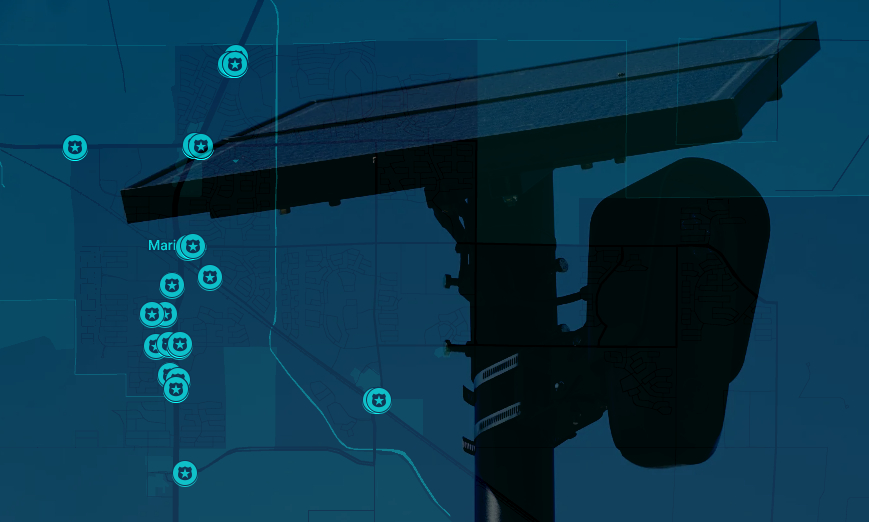
In the past two years, Maricopa has quietly expanded its automated license plate reader network by more than 40%. The expansion has drawn fresh criticism from privacy advocates, who argue the technology is less about catching criminals and more about fueling a national surveillance system.
The cameras, manufactured by Atlanta-based Flock Safety, are mounted on poles and powered by solar panels. They capture passing vehicles and feed the images into searchable databases used by law enforcement nationwide.
Earlier this week, Maricopa Police Chief Mark Goodman defended the program, calling it an investigative tool — not a surveillance system.
“These cameras are strategically located on major roadways and arterials to assist officers in solving crimes such as stolen vehicles, missing persons and locating suspects wanted for serious offenses,” Goodman said. “The system is not capable of facial recognition, livestreaming or constant monitoring of individual activity.”
But Will Freeman, founder of the watchdog site DeFlock.me, argues that Flock’s growth is driven not by community demand but by what he calls a “network effect.”
“Flock is essentially a data broker disguised as a public safety company,” Freeman told InMaricopa. “Although their legal team words things otherwise, their major selling point is access to a massive network of data collected by their cameras. I say their cameras because they own all of them. They offer a subscription service to surveillance.
“As more departments around you get Flock systems, getting your own Flock system becomes more valuable because you’d have access to all their data as well,” added Freeman. “Maricopa is on Flock’s national network … This means they can search all cameras opted into the national network, around 90,000 currently, and all agencies on that network can search Maricopa’s cameras as well.”
Freeman calls the cameras an invasion of privacy. He pointed to an ongoing federal lawsuit in Virginia, where a retired veteran alleges Flock cameras logged his location 526 times between Feb. 19 and July 2.
“Flock searches don’t require a warrant,” Freeman said. “In fact, they don’t even require probable cause or reasonable suspicion. The only required fields are ‘reason’ and sometimes a case number. Among Maricopa PD’s reasons for the national searches are: case, intel, investigation, suspicious, disturbance, miscellaneous search, serve. That isn’t accountability. That’s checking a box to say they have the ability to audit people’s searches.”
Freeman said the scale of the network raises local concerns.
“The national network sees tens of thousands of searches per day, from departments with different policies and values,” he said. “What’s stopping someone from another department from violating Maricopa’s policies?”
Goodman, however, has stressed that the cameras are used only for legitimate investigations and that Maricopa police do not have the ability — or intent — to monitor ordinary residents going about their daily lives. Police point to multiple cases where Flock cameras directly contributed to arrests.
Since September 2022, InMaricopa has reported on at least 14 arrests credited to Flock technology. Most recently, officers used the system to track down a Tesla linked to an April liquor theft at the Circle K near Copper Sky. Flock cameras flagged the EV days later at Walmart, where police arrested 40-year-old Meltravon Berry Simes, a California man still facing a shoplifting charge after he failed to appear in Pinal County Superior Court in August.
Flock, for its part, says its systems include transparency portals, auditing features and what it calls “ethical guardrails.” The company says it was the first to create a public transparency portal for agencies that want to make camera usage available to residents.
For Freeman, though, the problem is fundamental.
“There is no substantial evidence that ALPRs effectively prevent crime, despite Flock’s unethical attempts to prove otherwise,” he said. “What they do is create a massive, permanent database of our movements. That’s not public safety. That’s surveillance.”
We mapped where the flock cameras are. You can see the map below.
Editor’s note: This map was created using data obtained through a June FOIA request by DeFlock. A new camera is also being installed at Maricopa-Casa Grande Highway and Anderson Road; it’ll be the city’s easternmost. We’re continuing to gather additional location data.






![Western Pinal Justice of the Peace Patricia Glover speaks during a City of Maricopa Republican Club on May 23, 2026. [Monica D. Spencer]](https://inmaricopa.com/wp-content/uploads/2026/05/20260529-spencer-teeple-republican-club-1-4-300x200.jpg)