
In February, four men were found hiding high in the Maricopa Mountains, just a few miles south of the city.
They were wearing camouflage over their denim jeans, camo ballcaps and jackets. One man peered through binoculars. Electronics were kept in dark satchels they carried with them. They were all carrying solar panels to keep their communication equipment fully charged in the midday sun.
They were tell-tale signs of cartel scouts, according to U.S. Border Patrol agents who managed to intercept these men through a stroke of blind luck.
“It was sun reflecting, hitting one of the solar panels,” one of those agents, Robert Ortiz, told InMaricopa. The scout’s presence was confirmed with the help of optical and thermal surveillance.
Those scouts, who had been positioned on a peak with a panoramic vista of the Maricopa Mountains near Hidden Valley, were watching a human smuggling route, typical for cartel lookouts.
It was a much-publicized bust, one that InMaricopa and its readers wanted to know more about. This route through which the cartel was sending migrants ran straight through Maricopa, a city in the Casa Grande zone of U.S. border patrol’s vast Tucson sector.
“These guys are really hard to get if we don’t have air assets available to us because they are going to see us way before we get to them,” explained Border Patrol Agent Robert Ortiz on a recent ride-along with InMaricopa.
Cartel scouts often install solar-powered equipment in remote observation sites, enabling them to charge radios and maintain communication with ground units coordinating smuggling routes.
“We know they’re there,” Ortiz added, “but since they’re so high up, they can see what’s coming way before it gets there. And they can hide. They can get away. There’s just so many places.”
Agents say scouts like these are almost certainly monitoring the border every day.
“Absolutely,” one agent confirmed. “It’s a business, yes.”

This scout’s operation, believed to be directed by factions of the Sinaloa cartel, underscores a central tension in border enforcement: While physical crossings may be visible, the planning and intelligence components often unfold far beyond the traditional line itself, embedded in the desert, supported by infrastructure and run with military precision.
Because of a growing partnership with the U.S. Department of Defense, agents were able to quickly respond and apprehend the men.
Ride Along
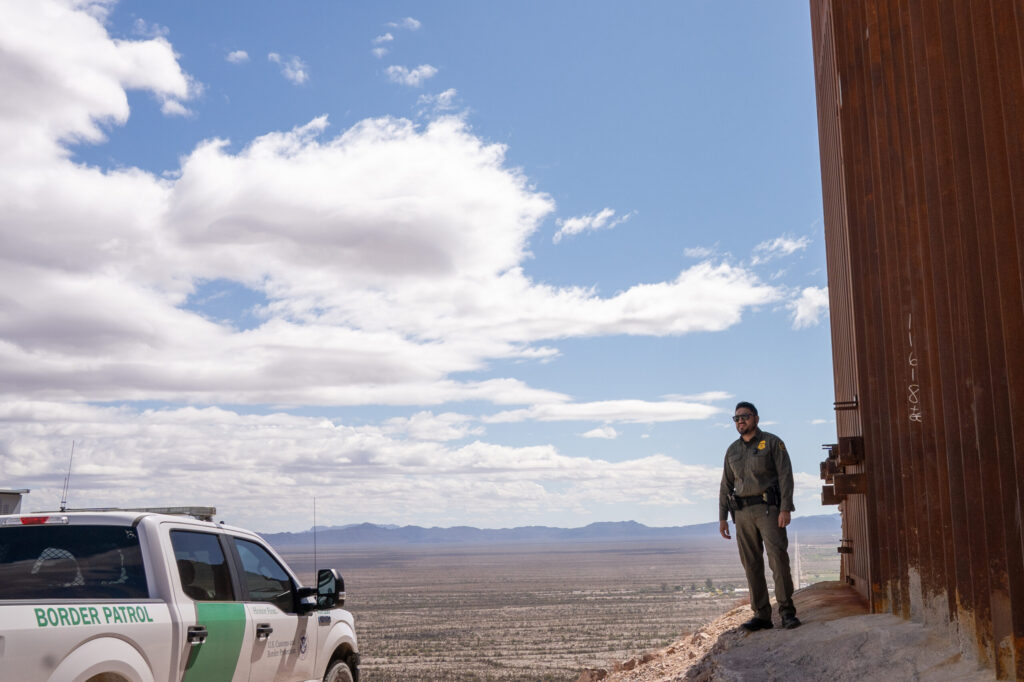
To get a sense of how agents were operating some 90 miles from the U.S.-Mexico border, InMaricopa met border agents at an outpost in Ajo to learn more about the changing realities.
As the truck clamored south, the road quickly changed from pavement to gravel to dirt. In the backroads of the Organ Pipe Cactus National Monument, conversation flowed about the agents’ personal lives and the history of the border patrol.
Suddenly, Supervisory Border Patrol Agent Jesus Vasavilbaso gave an order: “Stop the car.”
He spotted someone walking in the desert less than a mile from the border wall.
Ortiz stopped the conversation as quickly as he did the truck.
Two border agents with nearly four decades of experience between them scanned the horizon. They spoke in near code as they sat and watched for movement.
This time, it was a false alarm — just a blowing bush silhouetted against the late morning sun.
It is a different border and a different mis
sion than it once was, said these agents. At its height, agents in this 236-mile stretch of the border made contact with 10,000 migrants in a single day.
In 2023, Tucson’s sector chief John Modlin told Congress migrant encounters were quadruple
what they had been just three years earlier. Things had gone from “unprecedented” to “a point where I no longer have the correct adjective to describe what’s going on.”
Ortiz talked about politics by talking around politics.
“Since January, things have really changed,” he said, bouncing down the dirt road heading south. ”For the last three, four years, we were just inside processing, you know? The newer agents, all they know is processing. They don’t really know what it’s like actually being out here in the field.”
Statewide, illegal crossings declined by more than 70% between January and February, according to the Transactional Records Access Clearinghouse, a federal database of migrant border crossings.
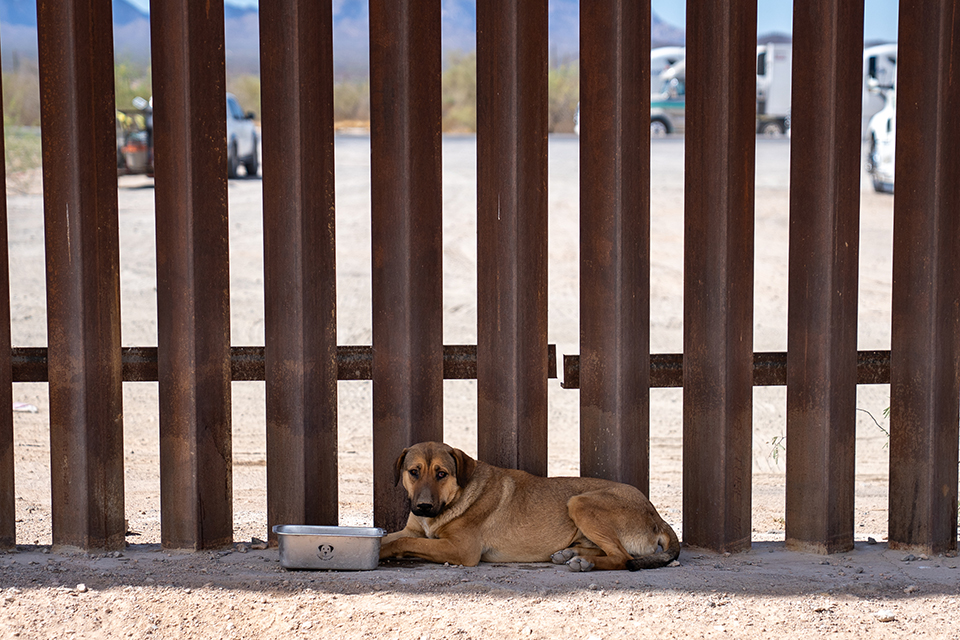
Now, across the entire Tucson sector, a massive swath of Arizona desert along 262 border miles and stretching another 100 miles north, agents average fewer than three dozen encounters per day.
The agents attribute the drop to new restrictions on asylum eligibility and increased detention capacity.
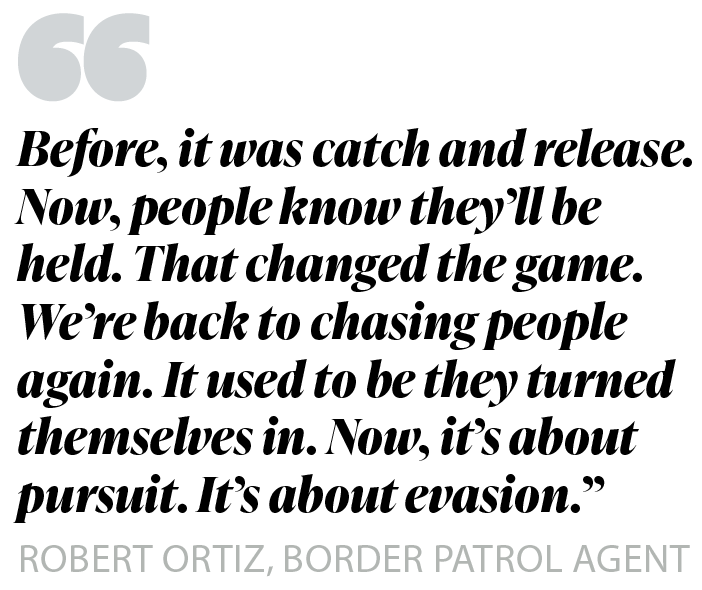
“Before, it was catch and release,” Ortiz said. “Now, people know they’ll be held. That changed the game. We’re back to chasing people again. It used to be they turned themselves in. Now, it’s about pursuit. It’s about evasion.”
Moving toward Maricopa
What made this Maricopa bust possible, agents say, is increased support from the Department of Defense.
On top of a steep, recently paved stretch of border, members of the U.S. military sit daily inside a modified pickup truck, utilizing surveillance equipment provided by an Israeli contractor. According to a DoD initiative, military units now assist Homeland Security operations with aviation support, intelligence gathering and monitoring duties. From this perch, they run surveillance equipment, filling support roles previously filled by the border patrol.
That gives agents new assignments into interior zones, like Maricopa, breaking up cartel scouted routes.

“What’s changed is that the DoD has the authority to move,” said U.S. Customs and Border Protection Acting Branch Chief John Mennell. “They can move to maintain eye contact or track [migrants]. They’re not going hands on, unless for defense, but they’re not arresting anyone. They call us in.”
Mennell calls it “find, fix and finish.”
“It’s a military phrase. They find the enemy, fix their location and finish them by bringing artillery down. This ain’t artillery, but the same principle applies. They’re calling in border patrol.”
“Our job hasn’t changed,” said Vasavilbaso, “but now, we can do more of it further away from the line because we have the DoD watching the cameras.”
Too much muscle?
While border patrol agents describe the military partnership as a force multiplier, critics see something else: a creeping militarization of civilian space. What began as logistical support is, in the eyes of watchdogs, rapidly morphing into a broader, less accountable surveillance state — one with few checks and a shifting sense of mission.
“There’s a different energy this time,” said Noah Schramm, border policy expert with the ACLU of Arizona. “The rhetoric has changed. The scope has changed. And the fear has changed.”
Schramm says residents in the border patrol’s enforcement zone are increasingly reaching out to his office, unsure of their rights if stopped by uniformed personnel — especially those wearing military patches instead of border patrol insignia.
“We’ve seen executive orders expand military jurisdiction to zones that blur the line between civilian and federal land,” he said. “If someone unknowingly steps onto one of these areas, the legal consequences could be severe — and totally disproportionate.”
The ACLU warns that even absent arrests, the symbolism of soldiers in the desert carries weight. In a region where the Constitution’s protections are already thin near the border, critics say the quiet normalization of military surveillance sets a dangerous precedent.
“We’ve seen the military provide logistical support at the border in the past, but this moment feels different,” Schramm said. “There’s a heightened level of rhetoric from the current administration that raises the risk of a significant expansion of military authority in civilian areas. That creates the potential for troubling encounters between armed military personnel and everyday residents of border communities.”

Schramm said the ACLU is especially wary of policies that increase surveillance and policing power in already heavily monitored areas, noting that both migrants and U.S. citizens in border towns are impacted. He cited a recent executive order establishing a 60-foot zone for military use along the border as a potential flashpoint.
“There’s a real fear about what happens if someone, whether a migrant seeking asylum or a local resident, accidentally steps onto land designated as military territory,” he said. “Those actions could carry criminal penalties, regardless of intent.”
While the ACLU has not seen widespread military personnel involvement in Arizona yet, Schramm said community members are increasingly reaching out with concerns. “Right now, it’s mostly fear and uncertainty,” he said, “but the risk of escalation is real.”

The business of exploitation
Vasavilbaso and Ortiz don’t share Schramm’s concerns. They say their focus is on intercepting human traffickers and stopping the cartels at the border.
Agents describe the cartels operating along the southern border as corporate in their organization and ruthless in execution.
“It’s like a franchise system,” one agent said. “The cartel runs the whole show, but they sublet areas to plaza bosses, who hire scouts, drivers and smugglers. Everyone pays a quota.”
Migrants pay between $1,000 and $1,500 just to be allowed to cross the line. That doesn’t include travel, lodging or the required camouflage kits they must purchase.
“People think it’s humanitarian,” said an agent, “but every person crossing without documents is putting money into cartel hands. That’s a hard truth nobody likes to say out loud.”
While this view may be operationally accurate, it skirts a more fundamental issue: why migrants feel compelled to turn to these criminal networks in the first place. Agents acknowledge most people they apprehend have been misled or exploited, but there remains little space in enforcement discourse for addressing systemic drivers of migration like poverty, violence and political instability.

Humanitarian crisis with tactical tools
The car went quiet as it rambled from a dirt road back to pavement. Looking out the window at the vast open desert, Vasavilbaso called the road by its nickname, “The Devil’s Highway.”
In 2001, a tragic incident unfolded just miles from the Ajo station, highlighting the perils faced by migrants attempting to cross into the U.S. A group of 28 Mexican migrants, primarily from the state of Veracruz, were led by smugglers through the treacherous terrain of the Cabeza Prieta National Wildlife Refuge. The smugglers abandoned the migrants with minimal water and false assurances that they were close to rescue.
Over the next several days, temperatures soared to 115 degrees and 14 of the migrants died, marking one of the deadliest border-crossing tragedies in Arizona’s history.
The incident drew attention to the dangers of increased border enforcement policies, such as Operation Gatekeeper, which had pushed migrants to take more perilous routes through remote and inhospitable areas. Critics argued such policies inadvertently led to more deaths by forcing migrants onto hazardous paths.
In response to the tragedy, U.S. and Mexican officials pledged to enhance cooperation to prevent similar incidents. The border patrol increased rescue operations and placed more emergency beacons in the desert.
“We do what we can,” said Ortiz. “We have EMTs, paramedics, helicopters. But at the end of the day, we’re law enforcement.”
Neither agent was in the region during the Yuma 14 incident, but both have experienced the harsh reality of border crossing.
Invisible border in the interior
What may concern residents most is the extent to which border enforcement now occurs far from the border itself. Maricopa is no longer an outlier. As cartel scouts and stash houses embed deeper into Arizona, the border patrol’s presence follows.
“We’re going where the intel sends us,” said Ortiz, “and the intel sometimes sends us north.”
Those small towns are all about relationships, added Mennell, the local border patrol chief.
“We don’t have enough border patrol agents to man these small towns,” he said of Maricopa and similar communities deeper in the buffer zone. “It’s going to be the cops who hear about this weird sh*t first.”
It was a single, weird sunray in a small town that led to the bust in the Maricopa Mountains.