

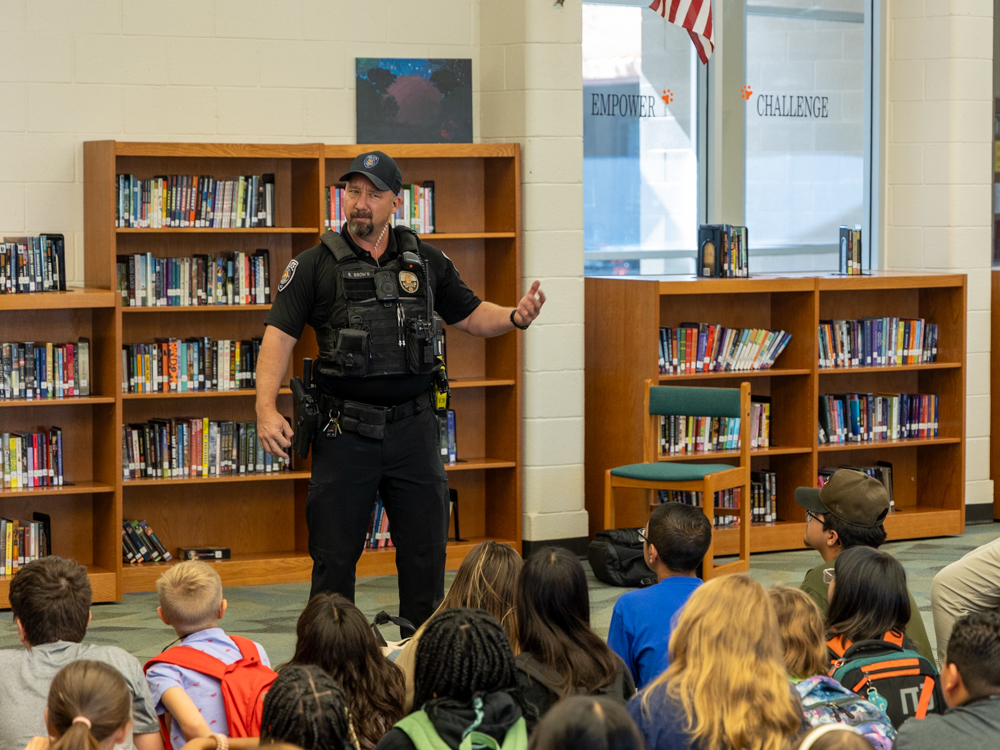
When Maricopa Police Officer Brian Brown made his final radio call and quietly ended a 20-year career serving and protecting the community, the reaction was anything but quiet. This longtime Maricopa cop served as a detective before becoming a beloved school resource officer. School leaders called him “a mentor, a guide and a familiar face students could count on every day” whose leadership, kindness and easy rapport with students and staff made him more than just the employee with a badge.
Now, as Officer Brown hangs up that badge after a career that began with the Navajo County Sheriff’s Office and grew alongside the City of Maricopa itself, he is reflecting on that storied career with InMaricopa and what surprised his wife about his retirement from law enforcement.
This interview has been lightly edited for readability.

Brown: I started in the Navy. After 9/11, I joined the Army National Guard (a transportation unit in Pine, Ariz.). I retired as a staff sergeant and served three tours, including with the first wave into Iraq in 2003, supporting transportation and frontline units during the initial occupation.
InMaricopa: What inspired you to join the Maricopa Police Department, and how has it been watching the city grow and change over the years?
Brian Brown: I started in the NCSO and spent a little over nine years there. Then I was hired by the Maricopa Police Department when the city was still up-and-coming — before the overpass, before a lot of the buildings. Watching the city and its police and fire departments grow was like watching an egg crack open. You don’t often get to see that kind of development from the inside.
In: What makes Maricopa special to you?
Brown: Loyalty. When I moved to the Valley, I applied everywhere: Phoenix, Scottsdale, Mesa, Chandler, Avondale, but Maricopa gave me the chance. When someone gives you that trust, you stick with them. I didn’t want to be just a number in a big machine; I wanted to help an agency grow and maybe leave a small legacy.
In: What innovations have most helped you on the job over the last 20 years?
Brown: Honestly, the body-worn camera. Most of our work is writing. Reports and citations are 95% of the job, while use of force is a tiny fraction. Body cameras have protected officers, improved transparency and generated great training material. When a complaint comes in, leadership can review the footage. Sometimes the issue goes away; other times it leads to policy updates or training. Either way, we learn.
In: Do you see body cameras as a net positive?
Brown: One hundred percent. People often see policing through TV or social media. Body-cam footage is unscripted. It shows split-second decisions. It can be hard for someone without that training to assess fairly, but transparency matters. We learn from mistakes, train to make better, faster judgments and keep working to hold the line between criminals and civilians.
In: How are you adjusting to retirement?
Brown: Honestly, I’m finally sleeping, like I haven’t in decades. After 40-plus years between the military and law enforcement, I took a couple weeks to decompress, and it hit me how tired I was. My wife even cried when she heard me say, for the first time in ages, “We’ve always got tomorrow.” That simple shift — allowing myself to rest — has been huge. I will start my first civilian job soon, so I’m leaning into the little things: slowing down, waking up without the radio and getting used to a life where I’m not always on call.
In: What message do you have for new recruits joining MPD?
Brown: Hang on. Have faith. Know you’re making a difference, even when it changes every day. Sometimes the job is simply waking up and doing it.
In: You’ve talked about leadership and the “machine.” How do you see that relationship with the community?
Brown: It’s symbiotic. We can’t do our job without citizen support, and citizens need us to show up for them. A leader is only as good as their people. Good leadership brings out good results through training, taking care of folks and standing up for them. That builds loyalty.
In: Any favorite assignments that energized you late in your career?
Brown: School resource officer. After heavy detective work (homicide and child sex crimes) moving into SRO work re-energized me. You see where law enforcement can make a big impact on students and their families. I served two years at MHS and three years at DWMS, and I loved it.
In: How do you define heroism?
Brown: Heroism isn’t just dramatic rescues. It’s waking up every day, doing a job that might not be noticed and making a difference as part of a larger system. Keep your head on a swivel, do your job, hold the line, learn from mistakes and be better because people are counting on you.


![Maricopa Police Chief Mark Goodman speaks to Maricopa City Council while presenting his department's annual report on April 7, 2026. [Monica D. Spencer]](https://inmaricopa.com/wp-content/uploads/2026/05/GOV-Crime-Stats-by-Monica-D-Spencer-300x200.jpg)


![William Senne, arrested June 2, 2026. [Pinal County Sheriff's Office]](https://inmaricopa.com/wp-content/uploads/2026/06/20260610-william-senne-arrest-300x170.jpg)



![Maricopa Police Chief Mark Goodman speaks to Maricopa City Council while presenting his department's annual report on April 7, 2026. [Monica D. Spencer]](https://inmaricopa.com/wp-content/uploads/2026/05/GOV-Crime-Stats-by-Monica-D-Spencer-150x150.jpg)