

Erika Fabbri has lived in the city of Maricopa, Arizona, for almost 7 years.
“I discovered a beauty that is more essential, raw, and authentic.”
Arriving in Arizona was a shock. It took me some time to get used to it.
Yet I quickly came to appreciate it.
Maricopa is not just the place where I live. It is a place that has taught me to breathe more slowly, to respect the power of nature, and to appreciate that rare sensation of open horizons where the sky and the earth seem to meet without boundaries.
Erika Fabbri, 42, originally from Vicenza, moved abroad for love in 2014. She met her husband in Vicenza, where he was stationed with the military.
Twelve years ago, they moved to Texas with their son, who is now 22. Almost 7 years ago, they arrived in Maricopa, Arizona. “The green landscapes of Italy were something I missed even when I lived in Texas, but when I arrived here in the middle of the desert, I must admit it was somewhat traumatic at first.”
However, Fabbri did not take long to adapt to this new reality. She continued her studies while also opening a business specializing in antique furniture restoration.
“I earned a master’s degree in psychology from the University of Phoenix, and last December, I completed a doctorate in educational leadership. Today I work as a school counselor.”
Does she miss Italy?
“Of course, I miss my family. I also miss our traditions like the morning coffee at the café and the aperitivo (happy hour).”
“When people ask me what it’s like to live in Maricopa, I always say that first you have to imagine the desert. But not an empty desert. Rather, a living, powerful desert, almost cinematic.”
Maricopa is located about 30 minutes south of the Phoenix metropolitan area, in the heart of Pinal County.
Today, the population is about 100.000, but until a few decades ago, it was little more than a small railroad center surrounded by desert land. The growth has been extremely rapid: new neighborhoods, schools, parks, and many young families. Yet despite the development, the landscape remains the true protagonist.
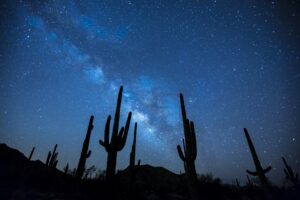
Arizona is vast. The saguaro cacti stand against the sky, and the sunsets are so intense they seem almost unreal.
We are also relatively close to Mexico, about three hours by car from the border, near Nogales. This proximity is strongly felt: Mexican culture, especially Mexican cuisine, is part of everyday life.
The presence of Native American communities also adds a unique dimension to Maricopa. Nearby is the Ak-Chin Indian Community, a federally recognized tribal nation.
Native reservations in the United States have a form of sovereignty that allows them to manage certain economic activities independently, including gambling. For this reason, casinos are common on reservations and represent an important source of economic development and funding for schools and community services.
One important landmark here is the Harrah’s Ak-Chin Casino, which attracts visitors from across the state.
Maricopa is not a “historic” city in the European sense of the word. It is more like a fragment of the American New West, where the sun is relentless, the desert commands respect, and history is felt more in the landscape than in the buildings.
Living here means learning to look far into the distance, toward a horizon that seems endless.
“For me, living in Maricopa means learning to coexist with immensity,” Fabbri says.
“It means living in a young city that grows every year, but that also carries within it ancient histories: Native communities, Mexican influences, forgotten battles in the desert, and the mythology of the Old West that still fascinates the world.”
“For someone arriving from Italy, everything feels bigger: the skies, the distances, the silence. At first, it can be disorienting. But slowly you realize that within that vast space there is a form of beauty that is more essential, more raw, and profoundly authentic.”
INITIATIVES
Muscle Cars for Enthusiasts
In addition to its residents, Maricopa attracts visitors from across North America. The city offers high-quality golf courses and facilities for motorsport enthusiasts, including racetracks for sports cars.
“During the months of the pandemic, my husband and I created the group Muscle Cars of Maricopa to bring together enthusiasts of classic and sports cars from across the state for local events.”
These gatherings have not only connected car enthusiasts but have also brought visitors into the community, benefiting local bars, restaurants, shops, and small businesses.
EVENTS
Deep roots between Mexican culture and Native traditions
In spring, the Wild West Music Fest brings music, food, games, and activities for families. In autumn, during Stagecoach Days, the city celebrates its local history with shows, exhibitions, and cultural initiatives. These events create a sense of belonging and remind everyone that Maricopa is a young and growing city, but with deep roots shaped by Mexican culture, Native traditions, and the imagery of the American West found at every corner.
WILDLIFE
Between wild horses and desert hares
The local fauna is very diverse. At night, coyotes can often be heard in the distance. In the surrounding areas, javelinas, desert hares, rattlesnakes, and wild horses live. More rarely, in the more remote areas, mountain lions and bobcats can also be found; large and elusive felines that prefer to avoid humans. In the sky, it is easy to see hawks and other birds of prey gliding above the plains, suspended in the warm desert air currents.
AT THE TABLE
The cuisine of “home” is Mexican
Because of its proximity to Mexico, Mexican cuisine is part of daily life here.
“It is not considered ‘ethnic cuisine’; it is simply everyday food.”
Dishes such as enchiladas, tortillas, and jalapeño peppers are common. The Sonoran hot dog, born in the Mexican state of Sonora, is also popular. Another well-known dish is the cheese crisp; an open flour tortilla topped with melted cheese. And of course, there is frybread, a traditional food connected to Native American culture.
CURIOSITY
The Western and John Wayne
Perhaps the most iconic and almost mythical aspect of this area is that the famous actor John Wayne once owned a ranch here. The city’s main road bears his name: John Wayne Parkway. Driving along it feels like traveling through a piece of Western imagination: ranches, horses, and endless open spaces.
CLIMATE
Haboob: when the sky turns ochre
In summer, the heat is extreme. Temperatures can easily exceed 45°C (113°F). The air shimmers, the asphalt burns, and daily life adapts to the rhythm of the sun. Then come the summer monsoons. Suddenly, the sky changes color, and a wall of dust appears on the horizon. These are haboobs. Gigantic dust storms that move across the desert, enveloping everything in an ochre-colored light. It is an impressive spectacle, almost primordial.


![RJ Ruiz and Elvenee Dees practice roping at their Hidden Valley home on May 9, 2026. [Monica D. Spencer]](https://inmaricopa.com/wp-content/uploads/2026/06/20260509-spencer-dees-rodeo-family-web-04-300x200.jpg)





![RJ Ruiz and Elvenee Dees practice roping at their Hidden Valley home on May 9, 2026. [Monica D. Spencer]](https://inmaricopa.com/wp-content/uploads/2026/06/20260509-spencer-dees-rodeo-family-web-04-150x150.jpg)