



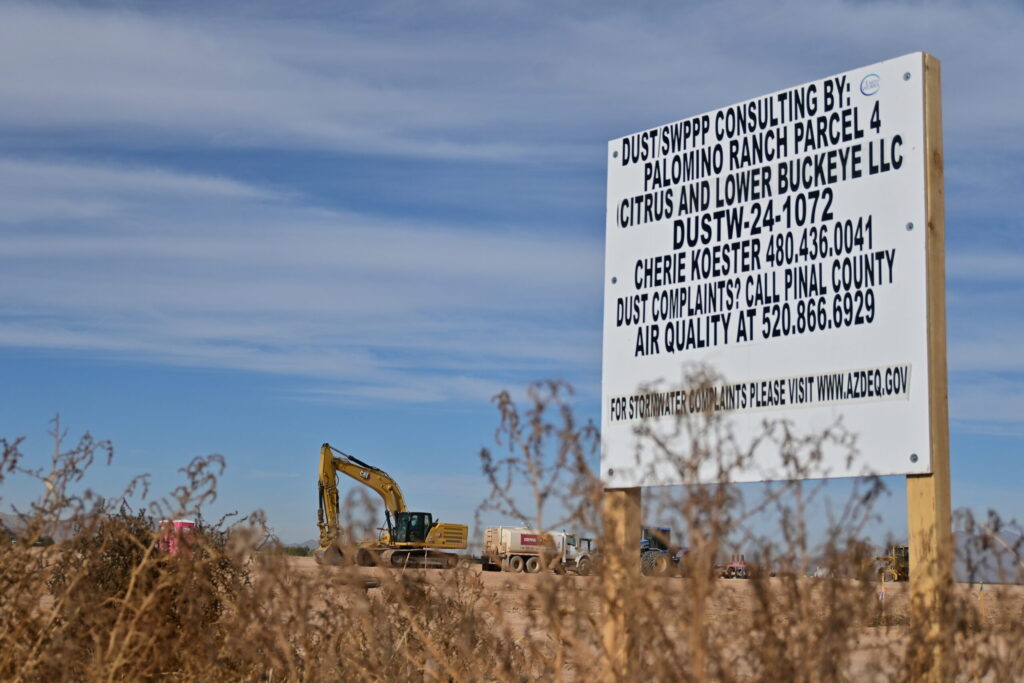
Arizona’s new “ag-to-urban” water law is now being put to the test south of Maricopa.
The program, touted last year the most consequential Arizona water policy in decades, is drawing its first wave of applicants. Four of nine pending applications statewide are tied to land in the Maricopa Stanfield Irrigation and Drainage District, according to a report published today by The Arizona Republic.
If approved, those applications would retire 334 acres of farmland and convert the associated irrigation rights into groundwater credits that can be applied toward a required certificate of assured water supply.
That certificate has been a roadblock for years.
After updated groundwater models showed parts of Pinal County could not demonstrate a 100-year assured water supply for new homes relying solely on groundwater, major projects stalled. Developers could own land and hold entitlements, but without water certification, construction could not move forward.
The ag-to-urban law, signed last year by Gov. Katie Hobbs, allows landowners who have actively used grandfathered irrigation rights to permanently relinquish those rights in exchange for groundwater credits. In the Pinal Active Management Area, 1 acre-foot of credit is granted per acre of retired farmland. Developers then have five years to apply those credits toward water supply approval.
The Maricopa-area applications involve land west of Starlight Homes’ Amarillo Creek community. That area includes Palomino Ranch, a 634-home subdivision on Papago Road that broke ground in December 2024.
Palomino Ranch was originally approved more than 20 years ago and received final plan approval from the Pinal County Board of Supervisors in September 2024. Builder Century Communities later submitted updated housing plans featuring 10 single-family models ranging from about 1,500 to 2,800 square feet.
In mid-2025, a Century representative told InMaricopa that model homes would not open any time that year. No timeline was offered, and no specific reason was given at the time.
The water certification bottleneck now offers context for why projects in the area have moved cautiously despite approvals and ground activity.
Palomino Ranch is also among the parcels included in Maricopa’s 2022 pre-annexation agreements covering 5,742 acres south and east of the city. City officials said those agreements ensured future homeowners would fund fire protection and infrastructure through development and impact fees rather than shifting costs to existing residents.
Editor’s note: Interested in how fire protection is being funded in Amarillo Creek and other future subdivisions in yet-to-be-annexed areas south of Maricopa now that homes are rising and residents have moved in? InMaricopa has been investigating how the South Maricopa Fire Association uses liens to enforce payment, despite not operating its own firefighters or trucks. Look for the full report in the March edition of InMaricopa magazine, arriving soon in your mailbox.





![Miranda Webster. [Submitted]](https://inmaricopa.com/wp-content/uploads/2026/10/20261005-miranda-webster-exceptional-300x188.jpg)









3 Responses
If water is a big issue, then developments should be planned with adequate green space.
Thank you for this timely article. Taking Agricultural Water credits and applying them to allow the developers to build un-told amount of dwelling units should scare every citizen and local government official. This whole propostion can only be driven by the lobbyists representing the developers. This application MUST be examined and argued so EVERY FACT is put in front of the the public!! How many credits will the developers be granted? How much water did the crop use ON A YEARLY BASIS? How much food did this water use provide? What about the carbon offset and favorable ambient temperature this crop provided? What will we eat if all of our Ag water is now allocated to houses? Just how does the math work? (up to 7 dwelling units/acre: 7 x 3.2 people/house @ 100 gallons/day = 766,500 gallons/year/365,900 gallons/acre foot = about 2 acre feet of water vs 1 acre of cantalope (grown by sub – surface drip) which is 1.5-1.7 acre feet. This doesn’t pencil out!! START ASKING QUESTIONS!! The State legislature used the WORST CASE SCENARIO for thier arument – alfalfa grown by flood irrigation. Most farmers now are using pivots, sub surface drip and are resting at least half thier land to save water. Many crops use LESS water than houses and PROVIDE OUR FOOD, AND DAIRY PRODUCTS!!!
It would also be more water conscious for farmers to pivot away from monoculture and steer towards polyculture practices which not only conserves water, but lessens the need for pesticides as well as providing another avenue for profit.
I transformed my backyard from dust and rocks to a permaculture food forest and I only need to water it maybe twice in the summer and I haven’t had a pest issue ever.
One would think farmers would employ the same tactics but…nope.