

If you’ve been poking around Maricopa’s social media or candidate campaign pages the last couple weeks, you’ve likely encountered a set of renderings of a downtown vision.
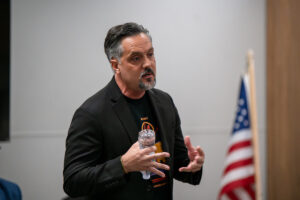
That is actually the AI-generated brainchild of city council candidate James Singleton.
The former Maricopa Planning and Zoning Commissioner recently released a 32-page document outlining some detailed revisions and additions to the city’s general plan. His former colleagues voted 5-1 this week to advance the plan to city council.
It’s a hefty critique of the plan — most comments left between March 2025 and February 2026 were just a few sentences long — but Singleton said it’s meant to build on the existing plan and offer more specific ideas for how the city can grow through the next decade.
“I think this deserves more than three minutes [in public comment],” he told InMaricopa. “That’s too short and you’re kind of limited on what you can post in online comments. So I was just like, let’s make a full-on document.”
Singleton said he spent roughly two months developing the document through an AI tool, feeding it the general plan, housing study, the budget and resident feedback. While he didn’t consult professionals in urban planning, he did reach out to members of the zoning board and others around the city for feedback.
“Some residents have said, ‘Oh, that’s the Maricopa I want to live in,’” he recalled.
Overall, AI generated 12 recommendations for expanding areas of the general plan, such as creating a defined set of expectations and possible locations for a downtown area. Other suggestions included a deeper look at how the city could better utilize its partnerships with local colleges and universities, and creating a formal scorecard for many areas of the general plan.
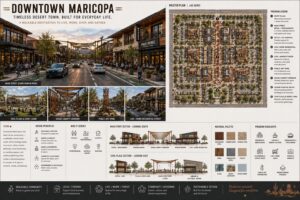
“A walkable downtown does not happen on its own. It takes clear policy to make it happen,” he wrote.
Singleton said he hopes to bring this type of background in technology to city leadership.
“I’m very data-driven. I’m a software engineer by trade, so I love data,” he said. “I strive to be able to put things together and share it as much as possible.”











4 Responses
Ok… Is it just me, or does anyone else find this somewhat concerning? I think James is a great candidate, and I plan on voting for him… but c’mon. As a software engineer, you should know better. Using generative AI to help shape our community’s general plan is a representational problem worth taking seriously. These tools are probabilistic language models- literally based on the probability of what words/image pixels should be combined to produce text or images that are most closely related to the prompt. They do not actually know Maricopa. They generate outputs based on patterns learned from massive amounts of training data, and that data skews heavily toward what researchers call WEIRD sources: content produced by Western, Educated, Industrialized, Rich, and Democratic populations. That means the model’s suggestions about what a good community looks like are being filtered through assumptions that may have nothing to do with who we are or what we need.
A general plan is supposed to reflect the real priorities of this community, including the people who are hardest to reach through traditional engagement processes. When AI is used as a shortcut, it does not replace that input with something neutral. It replaces it with a statistically averaged version of somewhere else. The residents with the most at stake in decisions around land use, zoning, and infrastructure are often the least represented in the data these models were trained on.
This is not an argument against using technology (I am a huge fan of it). It is an argument for making sure our planning process actually hears from our community rather than outsourcing that responsibility to a tool that was never trained on our voices.
iheart:
I agree. I am hoping we are not so predicable whereas to have AI determine our needs. It lays a starting point and from there humans decide what is best.
While I share your skepticism and concern regarding AI tools, some of your specific criticisms here seem to miss several key points that were covered in the article (although the article does neglect to call out any specific AI tools used by name). The model was fed our local data and resident feedback. The document was reviewed by members of the zoning board and other local residents. There is a big difference between AI slop churned out by an LLM in a minute, and spending two months developing a report with the help of AI tools.
I’m not against technology, but people are relying on AI a little TOO much. When taken into consideration that LLMs are learning from mostly social media – which is filled with illiterate idiots, the end result will obviously be AI that is equally illiterate and idiotic.
“Please computer, think for me” is not human progress. I’d much rather hear ideas from someone who used their actual brain/imagination than AI slop.