


In the desert, you learn the rules early.
Check your shoes before putting them on. Check the high temperature before heading out. Turn off the sink when you brush your teeth.
For Lily Surmay, those lessons stuck.
“I grew up in the desert. You learn those lessons early,” she said. “That respect for the environment really stayed with me.”
Today, Surmay works as a water conservation specialist with Global Water Resources, where her job is less about enforcing rules and more about helping locals rethink their everyday relationship with water.
“I want people to slow down and think about water conservation,” she said. “It’s part of our lives every single day, but we don’t always stop to think about it.”
That awareness is especially important in a city like Maricopa. It’s one of the fastest-growing cities in the state, so as new homes and neighborhoods grow, so does the demand for water.
That demand comes as supply faces increasing pressure across the Southwest. Declining snowpack in the Rocky Mountains has reduced flows into the Colorado River, while rising temperatures and Arizona’s population growth adds further strain on water.
“We only have a limited supply. If demand keeps increasing and we’re not conserving, it becomes harder to keep up,” Surmay said.
But rather than framing that reality as a crisis, Surmay sees it as an opportunity. And that starts with both innovation and everyday habits.
Right water, right use
At the center of that effort is Global Water Resources’ approach known as “Total Water Management.”
“It’s really about using the right water for the right use,” Surmay said.
That means drinking water is reserved for kitchen taps, while recycled water is used for irrigation, landscaping and other non-potable needs. By managing the water cycle from delivery to treatment to reuse, the system reduces its reliance on limited freshwater supplies.
And Surmay says that impact is significant. Global Water recycles nearly a billion gallons of water each year, part of a long-term strategy designed to support growth while conserving resources.
That requires major investment.
Global Water has spent millions building and maintaining water, wastewater and recycled water facilities. That includes miles of “purple pipe,” a separate system that delivers recycled water for outdoor use.
Those systems are designed not just for today’s residents, but for the city Maricopa is becoming.
“It’s really a constant cycle: investment, technology and education all working together.”
Educating the community
Surmay’s job truly enters the equation by taking that message to the masses, and it’s not just standing at a booth handing out brochures.
She attends events, answers questions from residents and provides resources ranging from conservation guides to simple tools like leak detection tablets or shower timers.
She also brings that message to younger audiences. Surmay works with schools and youth programs to help bring water education into classrooms and community events aimed at kids.
For example, the annual Maricopa Water Festival every winter brings hundreds of fourth grade students to hands-on stations to learn about ground water, watersheds and conservation.
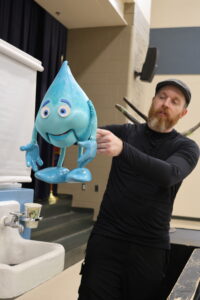
Another program, created with the Great Arizona Puppet Theater, uses storytelling to teach younger students about water waste. It’s a bit like “The Lorax,” but set in an Arizona home.
“It follows a character named Zoner who has a very wasteful water lifestyle,” she said. “He learns how bad that is when a drip appears out of his leaky faucet to teach him why saving water matters.”
And the message seems to stick. In fact, Surmay learned water conservation the same way while growing up in Tucson.
“When you start young, those habits stick. Kids will even reprimand their parents,” she said.
Do small actions really matter?
It’s a question Surmay hears often: Can one person really make a difference?
Her answer is yes.
“It may seem small, but daily habits can have a meaningful impact on our water supply,” she said. “For example, if one person saves 20 gallons a day, that’s 7,300 gallons a year. If 10,000 people commit to doing that, that’s 73 million gallons saved.”
Many of the most effective conservation steps are the simplest: fixing leaks, shortening showers or watering landscapes at dawn or dusk.
As for longer-term changes, Global Water offers rebates for smart irrigation controllers or incentives for replacing grass with drought-tolerant landscaping.
For Surmay, the goal isn’t about perfection. It’s about awareness, especially in a growing city.
“I don’t want people to see water conservation as restrictive,” she said. “It’s about making sure we have enough water for the future. You can start small and grow from there.”
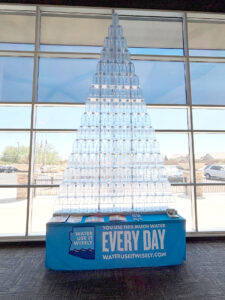
Easy ways to save water
Choose a front-loading washing machine. It uses two-thirds less water than a top-loader.
When washing your car, fill a bucket instead of letting the hose run.
When thawing food, use warm water heated in the stove or microwave or thaw in the refrigerator.
Toilet leaks are silent! Test your toilet at least once a year for leaks and make sure your flapper is working properly.
Install a high-efficiency or dual-flush toilet.
Use a cup of water for shaving instead of letting the water run.
Statistics
The average Arizona resident uses 120 gallons of water every day.
Seventy percent of Arizonans’ total water consumption goes directly toward outdoor use.
Switching to a WaterSense Smart Irrigation Controller saves the average homeowner 15,000 gallons annually.
Running a sink faucet for just five minutes wastes 10 gallons of water.
A sink that leaks one drop per second can waste an estimated 3,000 gallons of water annually, enough to fill a quarter of a swimming pool.
One square foot of grass uses roughly 50 gallons of water each year.
This content first appeared in the May 2026 edition of InMaricopa Magazine.
2026 May issue of InMaricopa MagazineSPONSORED CONTENT











3 Responses
The less you use, the less your bill will be.
I have not found this to be true.
Damn. Guess my assumptions about future life are wrong.