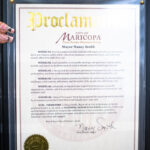


At Tuesday night’s Maricopa City Council meeting, Mayor Nancy Smith invited Maricopa residents to the dark side.
Just for 30 minutes. And for a good cause.
She issued a Dark Sky proclamation for International Dark Sky week, inviting residents to recognize the natural splendor of the stars.
“ This is called a Dark Sky Lights Out event,” said Vice Mayor Amber Liermann. “We invite you do with your family is just to turn off your indoor and outdoor lights and sit outside as a family and enjoy the dark night sky.”
“Join your neighbors in turning off unnecessary lights and stepping outside to enjoy the beauty of the night sky from your own backyard, balcony or window,” read a Facebook post from the city following the meeting.
The Pinal County Board of Supervisors issued a similar proclamation April 2. Together, the two proclamations call attention to the growing problem of excessive artificial lighting that obscures stars, disrupts ecosystems and wastes billions of dollars in energy each year. It’s commonly referred to as light pollution.
From April 21 to 28, Maricopa and Pinal County will join communities around the globe in celebrating International Dark Sky Week, a campaign that highlights the environmental, economic and cultural importance of preserving natural darkness.
As part of the celebration, residents are encouraged to participate in a countywide “Dark Sky Lights Out” event on Monday from 8:30 to 9 p.m. The initiative asks individuals, businesses and municipalities to turn off all unnecessary indoor and outdoor lights for 30 minutes to reduce light pollution and experience the wonder of the stars.
The document emphasizes the environmental, economic and cultural impacts of light pollution, citing its disruption of human health and wildlife behavior, along with its drain on resources, which are estimated at $3 billion in wasted energy each year across the U.S.
“Light pollution doesn’t just block our view of the stars,” the proclamation reads. “It affects ecosystems, contributes to climate change, and robs communities of the natural beauty that should be part of everyday life.”
The proclamation also notes Arizona’s unique role in astronomy. Home to about 10% of the world’s largest telescopes and numerous high-profile observatories, the state has a vested interest in protecting its skies for scientific research and tourism. The document draws attention to Arizona’s status as a leader in dark sky protection, with economic ties to aerospace, defense, and education sectors.
About 80% of the world’s population lives under a dome of light pollution, according to DarkSky International, a nonprofit that leads the global effort to protect natural nightscapes. In many areas, including parts of Pinal County, residents may never see the Milky Way with the naked eye.
Maricopa, one of the fastest-growing cities in the county, is not an official “Dark Sky” city, but it does have longstanding policies aimed at curbing light pollution.
“The City of Maricopa has had a lighting code in place since its incorporation to help limit light pollution,” said city spokesperson Monica Williams on March 18. “We’re committed to keeping our skies clear, even as the city continues to grow.”
Maricopa’s municipal code requires downward-facing, full-cutoff lighting to reduce glare and skyglow. While not mandatory, the city encourages businesses and developers to install motion sensors and other energy-conscious lighting solutions.
Arizona is home to some of the darkest skies in the country, as well as world-renowned observatories including Kitt Peak, Lowell Observatory, and the University of Arizona’s Large Binocular Telescope. The state boasts more Dark Sky-certified communities than any other. Flagstaff was the first in the world to receive the designation, followed by Sedona, Fountain Hills and Bisbee.
The push to protect dark skies is not only scientific, but also cultural. “There’s no civilization in history that hasn’t turned to the stars for meaning,” said James Lowenthal, a professor of astronomy and prominent dark sky advocate. “Losing access to that sky is like losing access to a part of our humanity.”
To learn more about Pinal County’s Dark Sky initiatives, events and how to participate in the Lights Out event, visit Pinal.gov/DarkSkies. A full schedule of events and resources is available online.
The new moon is scheduled on April 27, the darkest time for night sky.






![Miranda Webster. [Submitted]](https://inmaricopa.com/wp-content/uploads/2026/10/20261005-miranda-webster-exceptional-300x188.jpg)