


Zipping yourself into a beekeeping suit for the first time can feel surprisingly nerve-wracking. You start by sliding one leg, then the other, into the stiff white pants, pulling them up awkwardly. Then comes the heavy and unfamiliar jacket, zipped all the way up over your shoulders, sealing you in. Finally, you tug the hood over your head, the mesh veil dropping in front of your face, and zip it closed.
In triple-digit heat, with the warm suit on, you walk toward the hive. The space no longer belongs to you — it belongs to the bees. And when you start messing with them, they don’t hesitate to turn it into a swarm. Perhaps they get inside your suit; hopefully, they don’t.
That’s by no means to say these small, bumbling insects are bad creatures. In fact, they are among the most valuable in the world, according to some locals, but they will defend their queen with their lives.
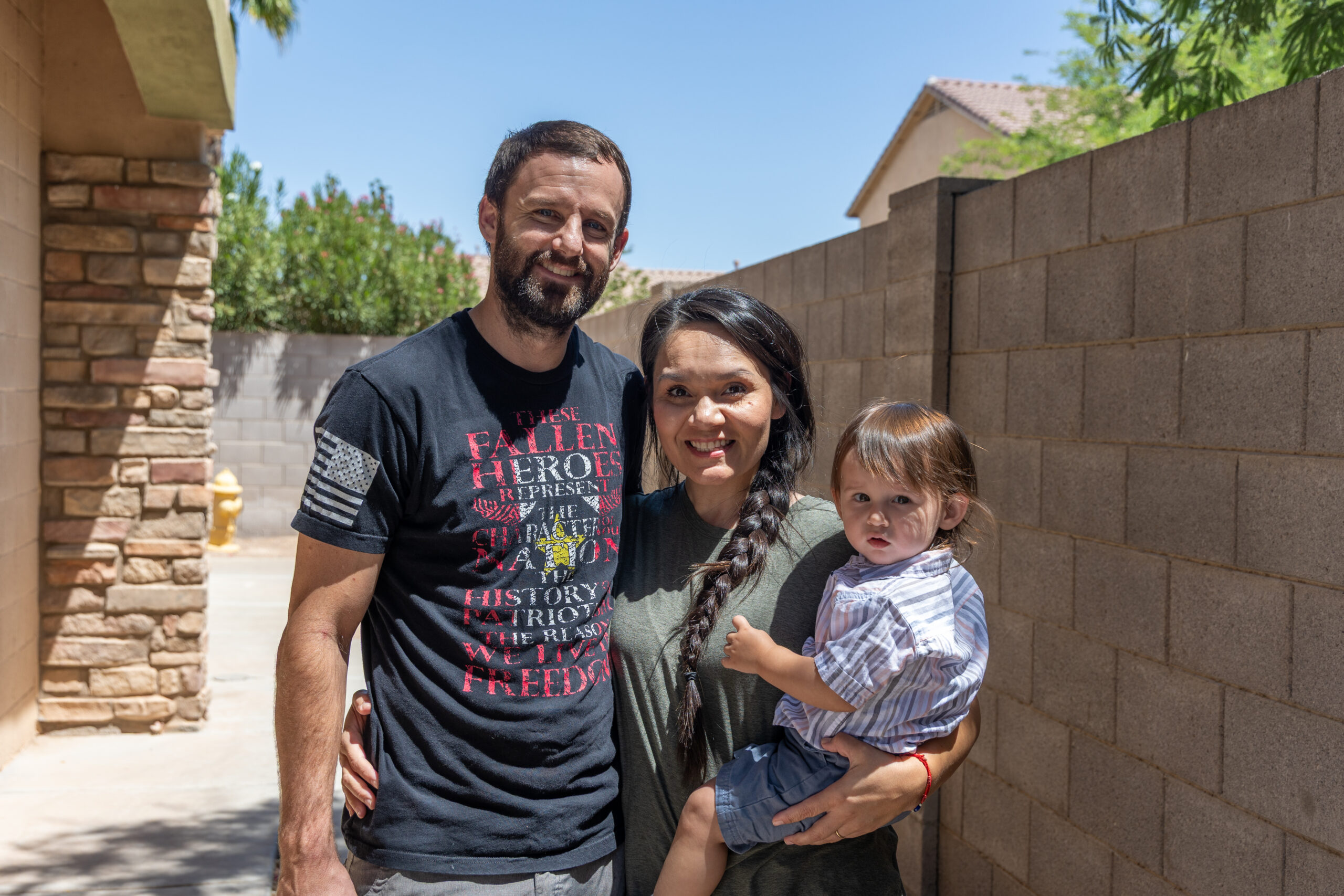
Rancho El Dorado residents Angela and Andrew Mattson, owners of Mattson’s Good Bees, maintain their own hives in Maricopa and Flagstaff and have seen firsthand what bees can do for the environment. The company’s name was chosen to teach their son, Antero, the difference between wasps and the good ones.
The couple began beekeeping as a hobby in 2020, and soon after setting up their first apiary, they noticed a change in the surrounding environment. In Maricopa, they use Flow Hives — wooden beehives with plastic frames that allow you to harvest honey from a tap while still being able to see inside.
When they placed their apiary, Andrew recalled, “Flowers started to come out more often on all the surrounding trees and bushes, but then lizards, roadrunners, birds and the whole ecosystem kind of changed — just because of putting out bees and an apiary.” He added, “Just putting small bees around in an area significantly changes it over a period of less than two or three years. It’s a huge change.”

Other local beekeepers who more recently joined the community said their fear of bees dissolved once they learned more about the insects.
“You want to get away from it until you find out what they do and why they do it,” Thunderbird Farms resident Liza Williams said. “Then you change your entire perspective: Don’t kill that thing — that’s going to pollinate something to feed the human race.”
Liza and her husband, Will Williams, are the owners of Teva Farms and are relatively new to beekeeping. They first put their two Flow Hives outside in March and have loved every second of it.
“It’s fascinating to sit and watch bees, to learn about them and to continue to be part of their world and help steward them because they do their own thing in this form of intelligence that they have,” Liza said. “It’s beyond human comprehension sometimes.”
During the brutal summer, when there is nothing blooming for the bees, the Williamses put some “bee bread” inside the hive — a mix of pollen, honey and nectar — to get the bees by until temperatures drop and their lavender farms are in bloom.
Sometimes, when Liza and Will maintain the hive, they wear suits; other times, they don’t. During an interview for this story, the bees were extremely passive and didn’t mind when their frames were pulled out for inspection.
“They’re doing what their God-given task is to do, and that’s all that’s on their agenda: go out, pollinate, bring whatever the queen needs, and they do that for 40 days,” Liza Williams said. “It’s also kind of sad because they still, in their mind, need to help the queen and the colony. So, in the last days of their life, they’ll drink a lot of water, fan the front, and then they’ll die.”
What’s the buzz about?
Thunderbird Farms residents Bill “The Bee Guy” and Monica Johnson keep millions of the little buggers in over 80 different hives at their home, across the Valley and on properties surrounding the popular sunflower fields along Ralston Road.
Liza Williams met the couple on Facebook when she was first learning the hobby and says Bill Johnson took her “under his wing” as a mentor. He was easy to find because of his online moniker, BilltheBeeGuy.
“He’s basically my living beekeeping bible,” Liza Williams said. “The way he beekeeps may not be the way that I beekeep, but in a sense he teaches me how to handle the problems when they arise.”
The Johnson couple first became interested in bees about five years ago, when they found a hive in their chicken feed. “We opened up the 55-gallon drums of feed, and it’s full of bees,” Bill Johnson said. “They weren’t aggressive, which made us very curious about it too.”
The couple did some research on beekeeping and found it was best to get not one hive, but two, so they could borrow resources from each one if the other was struggling. That snowballed, and after finding a mentor of his own, Bill Johnson became a full-time beekeeper who does removals throughout the Valley.
In the small groves around farmer Larry Hart’s properties in Hidden Valley sit dozens of stacks of the Johnsons’ boxed beehives, where he brings many of the rescued bees. Hart, who grew up in a beekeeping family, provided Bill Johnson access to his land for one small price.
“When he found out that I was keeping bees, he says, ‘You know, I’ve got a thousand acres out here. You can put your bees anywhere you want to keep them,’” the “bee guy” recalled. “The only thing he asked in return for being able to use his property like that is his wife, Gwen, likes to put honey in her coffee every morning. All I have to do is keep him in honey, which is pretty easy to do.”
The Johnsons frequently buzz about, performing constant maintenance on their many hives to help keep the bees healthy, prevent swarming and, of course, to collect the sweet fruits of their (and the bees’) labor.
One such example occurred one early morning in late July, when Bill Johnson went with reporters to split a bee box into another because it was filled. He chooses early mornings because of the cool temperatures.
Bill Johnson pulled up to a gathering of his beehives in an oasis under mesquite trees on the Hart farm and suited up before popping open the lid of one of his bee boxes. Before he had the opportunity to use his smoker filled with mulch mesquite, many bees came out to defend their hive, and a low humming buzz filled the air.
Once the lid was removed, Bill Johnson took out a frame at a time to inspect the combs, pointing out what each frame contained: brood comb for raising bees, super comb for storing honey, and what he was looking for — the swarm cell.
“A swarm cell is when the hive says ‘hey, we got too many bees in here, it’s time to split off’,” Bill Johnson said, his voice competing with the drone of the bees.
In a controlled environment, like a beekeeper’s hive, that swarm can be moved to another bee box to house the new bees, but in the wild, “those are the swarms you see in the neighborhoods, on the trees, on the side of buildings,” he explained.
At that stage, bees are loaded down with honey and pollen — the food they need to survive until they build their new hive. For situations like those, Bill Johnson is comfortable without a suit and just scoops up the bees by hand. He and wife Monica describe the feeling as “holding electricity.”
The bees will either die off or find a suitable home. “They move into eaves of your house, underneath your storage shed, your doghouse, your barbeque, your composter,” Bill Johnson said. “Once they move in and start making comb, that becomes their home.”
After Johnson moved the swarm cell to a new box, he placed it on top and left the bees to calm down. The bees would eventually begin filling the frames of that new box with more comb.

Sweet rewards
One thing most Maricopa beekeepers love just as much as saving the bees is the product they produce. It’s a sought-after ware many residents who know the beekeepers say they prefer over the store-bought stuff.
Monica Johnson harvests the honey from beehives across the Valley. Each location produces honey with a different taste, color and consistency, as bees fly up to 3 miles to pollinate crops.
Near the Hart farm, the bees tend to pollinate crops like cotton, alfalfa, mesquite and sunflowers, if the season is right. “Mesquite is darker honey,” Monica Johnson said. Motioning to a more golden nectar, she said: “That sunflower honey is my ticket. That stuff is sticky.”
One of her favorites, however, came from a hive in Casa Grande. She’s not quite sure what contributed to it, a batch that stood out for her because of its unique flavor profile.
“The last three batches we’ve got from there, pulled from our hives, have this burnt, buttery flavor,” Monica Johnson said with a smile. “I’m like a wine connoisseur; it’s pretty neat.”
After each removal, she gives the homeowner a container filled with honey and comb.
“On one of my very first removals with Bill, I got pink honey. All the flowers were red in the area, and you could just see the pink-red-orangish of the pollen packed into the honeycomb.”
The Mattsons of Mattson’s Good Bees in Rancho El Dorado also collect honey and combs from their hives, but more casually. They produce about 64 ounces weekly during the summer months.
“Our mission is to save the bees, and if we can get honey out of it, then that’s great,” Angela Mattson said. “We don’t sell a ton of honey, but what we do is mainly family, friends, and then I put it online.”
Today, Liza Williams makes ChapStick with the beeswax. She plans to expand to candles, lavender honey-infused soaps with goat’s milk, and pies.
“They give a lot of natural sweeteners to everything else that we’re planning on doing as far as baking and stuff like that,” Will Williams said.
“Lemonade is on a whole other level with honey in it,” his wife added.
The Williams couple is actively working to make Teva Farm Maricopa’s version of Queen Creek’s Schnepf Farms or Gilbert’s Vertuccio Farms. They say their beehives will likely become an important part of creating their lavender-themed attraction.
“We raised our kids going to pumpkin patches,” Will Williams said. “We would love to bring that to the community of Maricopa through lavender and being able to relax and do different things.
“We’ll have the hives available for people to harvest their own honey.”
If there’s one message all the beekeeping couples wanted locals to know about the buzzy little bugs with which they’re all obsessed, it’s this: Call a beekeeper, not an exterminator.

A Game of Thrones
Honeybees function as a caste system with a queen, worker bees and drones. If the queen is mean, so are the bees. If the queen isn’t up to standards, they’ll kill her and replace her.
“If you’ve got a mean queen, then you need to go in and remove her, depending on how mean the hive is,” Thunderbird Farms beekeeper Bill “The Bee Guy” Johnson said. “They want a queen, they want to continue to procreate, so you wait three days and bring in a new queen in her cage, leave her on top of the frames so that they can acquaint themselves and get to know her.”
Sometimes that simply doesn’t work because the bees may reject her pheromones. The larger the hive is, the harder it is to match a queen.
“You come back the next morning, and they’ve killed her. Bees are a lot like street gangs: The larger the group is, the more hostile they are to other outside sources,” Bill Johnson said.
One common question he fields in the beekeeping community is: Do you just let those hostile ones die off? He doesn’t, citing he believes that goes against his “save the bees” message.
“Why don’t you just divide them and requeen them?” he asked, rhetorically. Splitting the hive into several different colonies and then giving each its queen tends to work better for him. “That’s responsible beekeeping, that’s how it’s supposed to be done.”
Once the new queen is accepted and starts laying eggs, the mean bees will eventually live out their life cycle and be replaced by nicer and gentler bees that match the queen.
“In the space of three or four months, you’ve gone from a mean hive to a very gentle hive,” Bill Johnson said. “That’s how it’s done in the removal business, that’s how we save the bees in my mind, rather than exterminate them.”
If hives are placed too close to each other, they can get aggressive toward one another, with the larger ones attacking the smaller ones: “It’s a game of thrones thing, survival of the fittest.”