
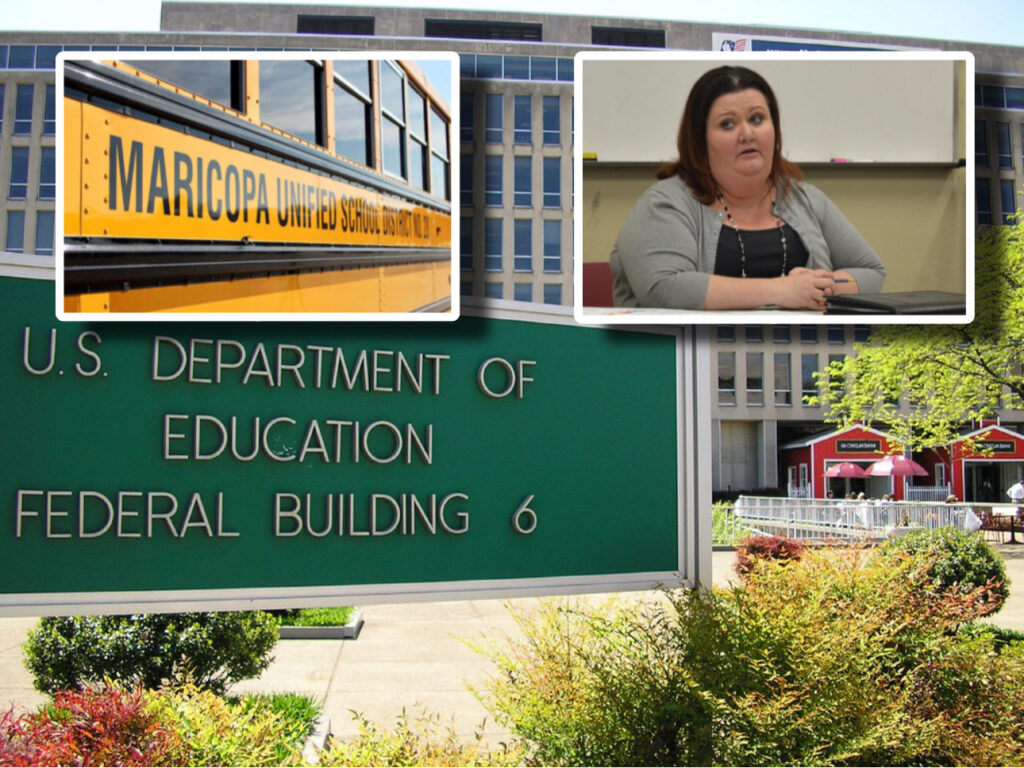
With the Department of Education effectively disbanded by Executive Order today, what does that mean for Maricopa students, educators and families? The simple answer is that no one knows at this point, but we set out to understand what school leaders are watching.
First, some context:
Last Thursday, President Donald J. Trump signed an executive order initiating the dismantling of the U.S. Department of Education, fulfilling a longstanding Republican objective to return educational authority to state and local governments.
The decision marks a seismic shift in American education policy, as generations of students have never known an education system without a federal DOE. Established as a cabinet-level agency in 1980 under President Jimmy Carter, the department has since played a central role in administering federal education funding and ensuring compliance with national education standards, although curriculum is set at the state and local levels.
Just days after that President Trump’s order, teachers unions sued, arguing that Congress must approve the department’s closure. Meanwhile, local school leaders across the country, including those in Maricopa, are bracing for its potential impact.
The Department of Education’s $268 billion budget touches school districts nationwide in numerous ways. Under the executive order, the administration announced that the Small Business Administration would assume control of the country’s nearly $1.6 trillion in student loans, while the Department of Health and Human Services will oversee school nutrition programs and special education services.
The department directs more than $15 billion to Title I schools, which support low-income students, and another $15 billion toward programs governed by the Individuals with Disabilities Education Act, better known as IDEA. In 2024, Arizona received $324 million from Title I, according to Department of Education data. All told, Arizona receives nearly $1 billion from the DOE every year.
Education Secretary Linda McMahon defended the decision in an interview with CNN, stating the department largely functions as an expensive, unneeded layer of red tape for federal funds to reach students.
“What [the DOE] is, is more of a pass-through of funding, which is appropriated by Congress by the way, and so we want to make sure that that funding continues in the departments where it needs to be, but at the same time give states the opportunities to be innovative and creative with their teaching,” McMahon said.
Public education leaders in Arizona have expressed both support and concern regarding the executive order.
Arizona Superintendent of Public Instruction Tom Horne downplayed the potential impact on state education systems to KJZZ recently.
“If [Trump] does close the Department of Education, the first thing I’ll do is throw a party,” said Horne to the public radio station last week. He wanted to reassure the public that key funding sources, including Title I, Pell Grants, financial support for children with disabilities, and federal student loan management, would be sustained.
“Getting rid of federal bureaucracy will give us some money to help with raising teachers’ salaries, which is something we absolutely must do,” Horne added. “We’re losing more teachers out of the classroom than are coming into the classroom.”
However, not all educators are as optimistic. Marisol Garcia, a middle school history teacher and president of the Arizona Education Association, warned that dismantling the department could disrupt funding streams and put thousands of jobs at risk.
“A former reality star and a WWE celebrity have formalized their plans to eliminate the U.S. Department of Education,” said Garcia at last week’s rally featuring Sen. Bernie Sanders and Rep. Alexandria Ocasio-Cortez in Tempe. “It’s bad because 90% of public educated students attend public education schools, 95% of our disabled students attend public schools. Arizona receives $1 billion of federal money and there are 20,000 jobs at risk.”
For districts like Maricopa Unified, uncertainty looms large.
MUSD relies on federal funding to support initiatives such as Title I programs for low-income students, special education services under IDEA and multi-year grants like Project Momentum. While preliminary reports suggest some funding will be preserved, no clear timeline or mechanism for reassignment has been established.
Mishell Terry, director of communications for MUSD, acknowledged the uncertainty.
“We remain focused on what matters most — our students, staff and families,” Terry said today. “As this situation develops, we will continue to share updates and work to ensure that essential services and supports remain in place across [Maricopa Unified School District].”
District officials are monitoring developments through their state and federal partners, documenting changes in funding and compliance requirements, and awaiting formal direction from the Arizona Department of Education.