

As the city of Maricopa continues to expand with new businesses and residential developments, so too does an often-overlooked consequence: light pollution. The artificial glow from streetlights, buildings and homes increasingly dims the view of the night sky, making it harder to see the stars and planets.
Pinal County has a Dark Sky chapter, but Maricopa is not an official “Dark Sky” city. One of Maricopa’s founding laws was keeping the lights low, though.
“The City of Maricopa has had a lighting code in place since its incorporation to help limit light pollution,” said the government spokesperson, Monica Williams. “We know that one of the things people love about Maricopa is the ability to enjoy clear night skies, and we’re committed to keeping that experience as the city grows.”
Maricopa’s municipal code (this one if you’re curious) includes requirements such as downward-facing, full-cutoff lighting to reduce glare and skyglow. The city also encourages businesses and developers to adopt “responsible lighting solutions, including motion sensors, to prevent unnecessary light pollution,” although it isn’t a requirement, said Williams.
Arizona has long taken the issue of light pollution seriously. The state is home to several “Dark Sky” cities — those that try to keep the lights low to keep the stars shining. Flagstaff (the first in the world), Fountain Hills, Sedona and Bisbee are the most prominent. The Grand Canyon too protects the number of lights that can legally face the night sky.
While Maricopa is not currently designated as a Dark Sky-certified city, it follows many of the same principles upheld by the nonprofit organization Dark Sky International. Arizona leads the nation in Dark Sky-certified communities, said Williams, highlighting the state’s commitment to preserving the night sky.
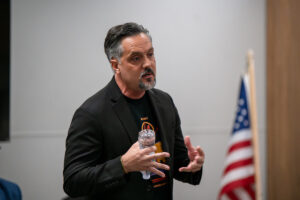
James Lowenthal, a professor of astronomy at Smith College in Northampton, Mass., and an advocate for reducing artificial light at night, stressed the importance of protecting natural darkness.
“Light pollution is artificial light at night that degrades the environment, makes the sky artificially brighter and shines into people’s windows,” Lowenthal said. “It can blind drivers and pedestrians, disrupt ecosystems and contribute to serious health problems.
“There’s a patchwork of laws across the U.S. addressing light pollution, from homeowners associations to city, state and even international regulations,” Lowenthal added, “but the reality is, this problem has an immediate solution — you just turn off the lights.”
Part of the solution is in LED lights that can be controlled with timers and dimmers to reduce their impact after hours, he said.
“There is no culture in human history that has not turned to the stars for its cosmology, its religion, its inspiration,” said Lowenthal. “It’s threaded inextricably through all parts of our culture. You can’t pick up a magazine or a book without reading about stars and seeing pictures of stars. Every flag has stars and moons. We name our cars and our microwave ovens and our televisions after celestial objects.”
This dude is space’s biggest hype man in America. Lowenthal emphasizes that the loss of natural darkness is not just a scientific or environmental issue but a cultural one.
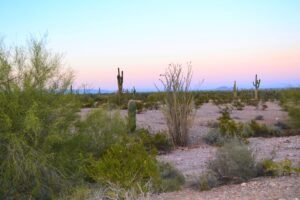
“The Milky Way is right over our heads every night. On a clear night, you should be able to see it,” he said. “But 90% of Americans can’t see it from where they live. That’s kind of like never seeing a rainbow in your life or never seeing a tree. Our home includes the stars and the Milky Way. Everybody should be able to see it.”
As Maricopa grows, those stars will get dimmer and dimmer.
These are our region’s designated dark sky locations: