
UPDATE 9:46 a.m. Sept. 20, 2024: A Celebration of Life will be held at 4 p.m., Oct. 5, at the University of Arizona Maricopa Agricultural Center, located at 37860 W. Smith-Enke Rd.
In lieu of flowers, the family requests donations be made to a cause or organization that is important to you.
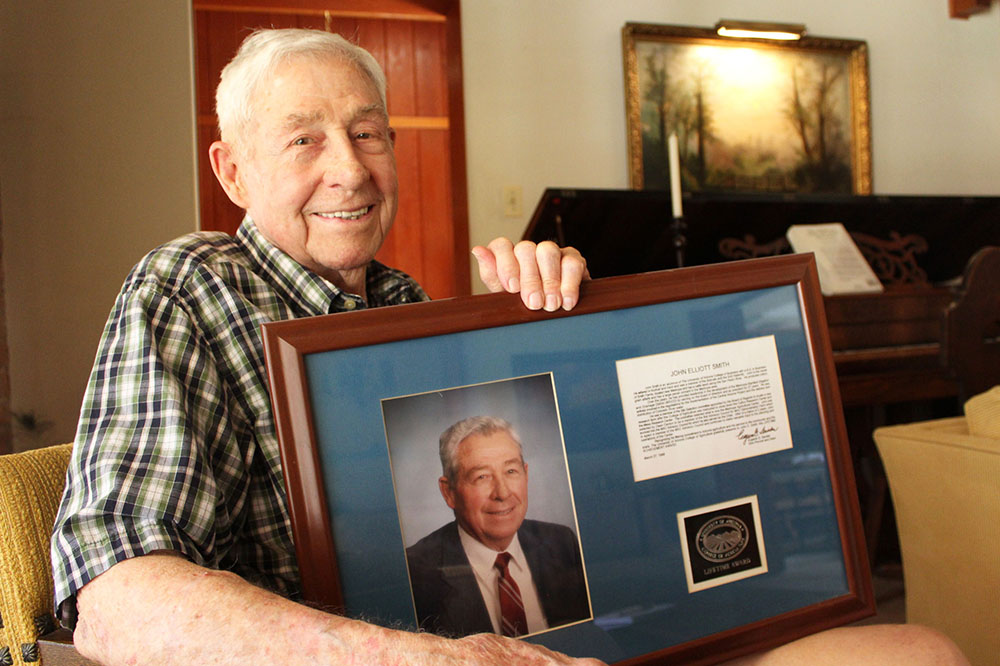
ORIGINAL STORY 11:20 a.m. Sept. 4, 2024: Maricopa pioneer and farmer John Smith, 96, died peacefully in his sleep at his home in The Villages at Rancho El Dorado Sunday morning.
Smith is survived by his wife of 73 years, Mary Lou, four sons Jim, Jack, Matt and Mark, daughter Lisa Balcer, 22 grandchildren and 49 great-grandchildren. John’s son Paul is deceased.
Mary Lou Smith is in an assisted living facility in Chandler, close friends of the family said.
Westward ho!
John Smith was born in Hobart, Okla., Sept. 8, 1927, and moved to Glendale at age 2 during the Great Depression and Dust Bowl era. He went to grade school and high school in the West Valley.
John Smith earned a business degree at the University of Arizona, where he played football with his friend and fellow Maricopa founding father Fred Enke Sr., who died in 2014. They were both Wildcats in the 1940s with Enke at QB targeting Smith, a wide receiver.
The Los Angeles Rams drafted Smith in 1950 but he “got injured pretty early on,” Balcer said. “He dislocated his shoulder.”
“When they came back, he and Fred [Enke Sr.] went into farming together, they had a partnership,” she added.
The pair bought 320 acres of farmland just off their namesake Smith-Enke Road. Their land ownership in Maricopa would balloon to several thousand acres.
A real Maricopa guy
The partners built Smith-Enke Road to access their farm. John and Mary Lou built the famous Smith home, nestled in The Villages at Rancho El Dorado community, in 1955. At the time, it was surrounded by cotton, grain, alfalfa, barley, wheat, sorghum and 25,000 pecan trees.
Smith and Fred split ways in 1963, when Smith took over the part of the farm near his famous Villages home, and Fred took the area that is now UofA’s Agricultural Center.
Smith was proud of his time on the UofA advisory board for the Maricopa Agricultural Center, the Arizona Power Authority, Maricopa-Stanfield Irrigation District and helping the community, his son Jack said.
“He’s a Maricopa guy, he wants to be buried there,” Jack said, recalling his father had long said, “Get a cemetery because I’m going to need it.”
Later in life, John was an avid reader, according to son Jack.
“He loved history, particularly Arizona history, southwest history and Maricopa History,” Jack said. “He knew all about the early Indian settlements, the American settlements along the river.
“He had lots of books, he knew all the sites, and he loved it, and he often liked to tell people about it,” Jack added.
‘A powerful man’
Smith’s neighbor and close friend Pete Lawrenson was one of those people with whom he loved sharing his wisdom.
“He was such a unique character,” Lawrenson said. “He was just a powerful man.”
Lawrenson, a snowbird, recalled meeting John at Christmas time in 2016, right after John hurt his knee.
“He asked me one day if I would take him down to Casa Grande to get a haircut,” Lawrenson said. “After he gets his haircut, he says, ‘If you’ve got some time, let’s just go for a drive and we’ll explore some country around here and I’ll give you history,’ so we did.”
For those two first winters, John would give his Lawrenson history lessons weekly.
“We’d go to Casa Grande and have breakfast real early in the morning, then he’s say, ‘Let’s go west today or let’s go down by Ajo,’ and we’d go exploring one day a week all through the winter. Those are my favorite memories of John,” Lawrenson said.
Making a splash
Smith was passionate about the book In the Early Days of Maricopa, compiled by other area trailblazers. The tome recalls when Smith “and the other community leaders got together and built the Maricopa swimming pool,“ said Balcer. Smith coached the swim team after with Shirley Ann Hartman.
“It was a really great thing for a little dirt town back in the day,” she said.
The Rotary Club of Maricopa had decided in 1956 that the community needed a swimming pool.
Smith and Enke, both Rotarians, donated 3.5 acres along Maricopa-Casa Grande Highway for the pool and a park. The cost of building a pool was estimated at $50,000, but Rotarians and local businesses donated enough in resources and labor to cut that to just over $24,000.
The Rotary Club started the city’s annual Stagecoach Days to help fund the pool. Smith and Enke took out loans to cover much of the rest of the expenses. When the overpass was built, closing the pool, Smith donated the money made by ADOT for scholarships for students Maricopa High School.



![Western Pinal Justice of the Peace Patricia Glover speaks during a City of Maricopa Republican Club on May 23, 2026. [Monica D. Spencer]](https://inmaricopa.com/wp-content/uploads/2026/05/20260529-spencer-teeple-republican-club-1-4-300x200.jpg)