
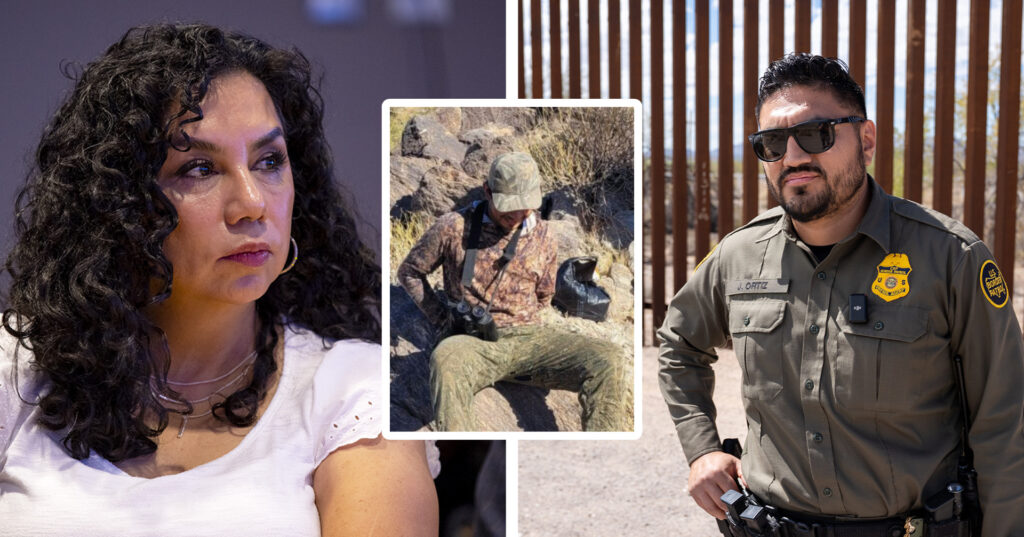
In March, InMaricopa reported that a suspected Sinaloa Cartel scout was arrested in the mountains of unincorporated Maricopa. It remains our biggest story of the year so far with more than 66,000 people having read the report.
Now, thanks to a resolution co-sponsored by state Rep. Teresa Martinez, Arizona voters will soon decide whether to label such operatives as foreign terrorist organizations under state law.
It is a move lawmakers say is necessary to protect public safety. Critics warn it could lead to civil rights violations and conflicts with federal immigration policy.
The Arizona Legislature just approved House Concurrent Resolution 2055, placing the measure on next year’s ballot. If enough voters support it, the Arizona Department of Homeland Security would classify transnational cartels as terrorist entities and authorize law enforcement to use “additional tools” to target them.
House rep for Maricopa: ‘They kill people’
Martinez, who represents Maricopa in the House, said she co-sponsored the resolution in response to increasing cartel-related violence and drug trafficking in border communities. (InMaricopa recently went on a ride-along with the U.S. Border Patrol to learn more.)
“These cartels are not boy scouts,” Martinez told InMaricopa in a phone interview today. “They traffic fentanyl, traffic women and children, and they kill people. They are terrorists, and we should treat them as such.”
Martinez said the measure would help distinguish between ordinary migrants and cartel members during enforcement.
“If someone is coming here to work and raise a family, they’re going to be treated differently than someone tied to a gang like MS-13 or Tren de Aragua,” she said. “These organizations are dangerous. If you’re on a terror list, you could be immediately detained or deported.”
The resolution comes after Gov. Katie Hobbs, a Democrat, vetoed similar legislation last year. By sending the measure directly to voters, GOP lawmakers bypassed the governor’s opposition.
“Why send it up just to get another veto?” asked Martinez. “Let the people decide if they want these cartel members treated like 5-year-olds.”
Martinez also framed the effort as a safeguard against future shifts in federal immigration policy.
“The Democrats want open borders,” she said. “This puts something on the books in Arizona, even if we get another Democratic president in 2028.”
It’s unclear whether a formal campaign will be organized to support the measure ahead of the election.
“I would imagine there will be a campaign to explain it to voters, but I’m not involved in those conversations,” said Martinez.
Civil rights advocates have raised concerns that labeling cartels as terrorists at the state level could lead to racial profiling, unjust detentions or interference with federal immigration enforcement. Critics also argue that existing federal law already allows for the designation of foreign terrorist organizations, and Arizona’s move could create legal complications.
Martinez pushed back.
“We’re not talking about the regular Joe trying to make a better life,” she said. “We’re talking about dangerous people who come here to do harm. The idea that we should sit back and give them opportunities to create havoc is absurd.”
Critics: Moms, dads could be wrongly tagged ‘terrorists’
Advocates and legal scholars have raised concerns about the proposal, warning that a state-level terrorism designation could lead to racial profiling, mistaken detentions and confusion between state and federal enforcement systems.
The advocates, including the ACLU of Arizona, argue that such sweeping policies “put lives in danger” by risking wrongful detention of asylum seekers and others legally present under U.S. law. They warn that expanding terrorism labels without the due process protections typically built into federal proceedings could entangle innocent people in immigration or criminal investigations.
Lynn Marcus, director of the Immigration Law Clinics at the University of Arizona and an expert in federal immigration law, said the proposal is unlikely to have any legal impact on federal enforcement, because immigration authorities are bound by federal, not state, definitions.
“Congress has its own definition of terrorist organizations for immigration purposes, such as bars to immigrating and to obtaining protection from removal [including asylum], and it defines them quite differently than the authors of this bill would,” said Marcus. “For any terrorist organization designation to impact federal immigration law enforcement, it would need to be made by the Secretary of State, not one of the 50 states.”
Marcus added that Arizona already incorporates Foreign Terrorist Organizations as defined by the Secretary of State into its criminal statutes. What’s new in this measure, she said, is an effort to define “drug cartel” in a far-reaching way.
“The proposed definition covers much more than drug trafficking,” Marcus told InMaricopa. “It includes human smuggling, which could encompass parents bringing their children across the border without inspection. That could, under this language, make a mother or father a member of a ‘drug cartel’ and thus a ‘terrorist organization.’”
She also noted that the law distinguishes between activities committed for profit, such as drug trafficking, and those that don’t require a profit motive, like smuggling a family member.
“I have no doubt that many people would support harsh treatment of people who participate in groups conjured up by the terms ‘drug cartels’ or ‘terrorist organizations,’” Marcus said, “but relatively few would expect those terms to extend to people who cross the border without inspection accompanied by a child.”
Critics also note that the U.S. Department of State already maintains a formal FTO list. Adding state-level designations could result in legal conflicts or undermine the established federal process.
The federal list has grown significantly this year. The Trump administration added 11 groups in the first five months of 2025, the most since the list started in 1997. Newly designated entities include major Mexican cartels such as Cartel de Sinaloa, CJNG and Tren de Aragua, as well as gangs and militias active in Latin America and the Caribbean.
Once an organization is labeled an FTO, the federal government seizes or freezes all the group’s assets under the control of U.S. financial institutions. Groups are barred from doing business with states and U.S. citizens. The intent, according to the State Department, is to “expose, isolate and disable terrorist actors” by cutting off their access to finances and international support.
Arizona is one of many Republican-led states pushing for more aggressive action against transnational criminal organizations, but one of only two border states. Texas as well as Florida and Michigan have introduced or passed resolutions urging the federal government to label cartels as terrorist groups.
The measure is expected to appear on the November 2026 general election ballot.