

It all starts with noticing something unusual.
Lights left on too long. A garage door left open for hours. A vehicle creeping down the street. Someone yelling several houses away.
For Maricopa Police Department’s community support specialist, Jim DeVenezia, that’s how most neighborhood watch groups begin: with a neighbor who decides to pay attention.
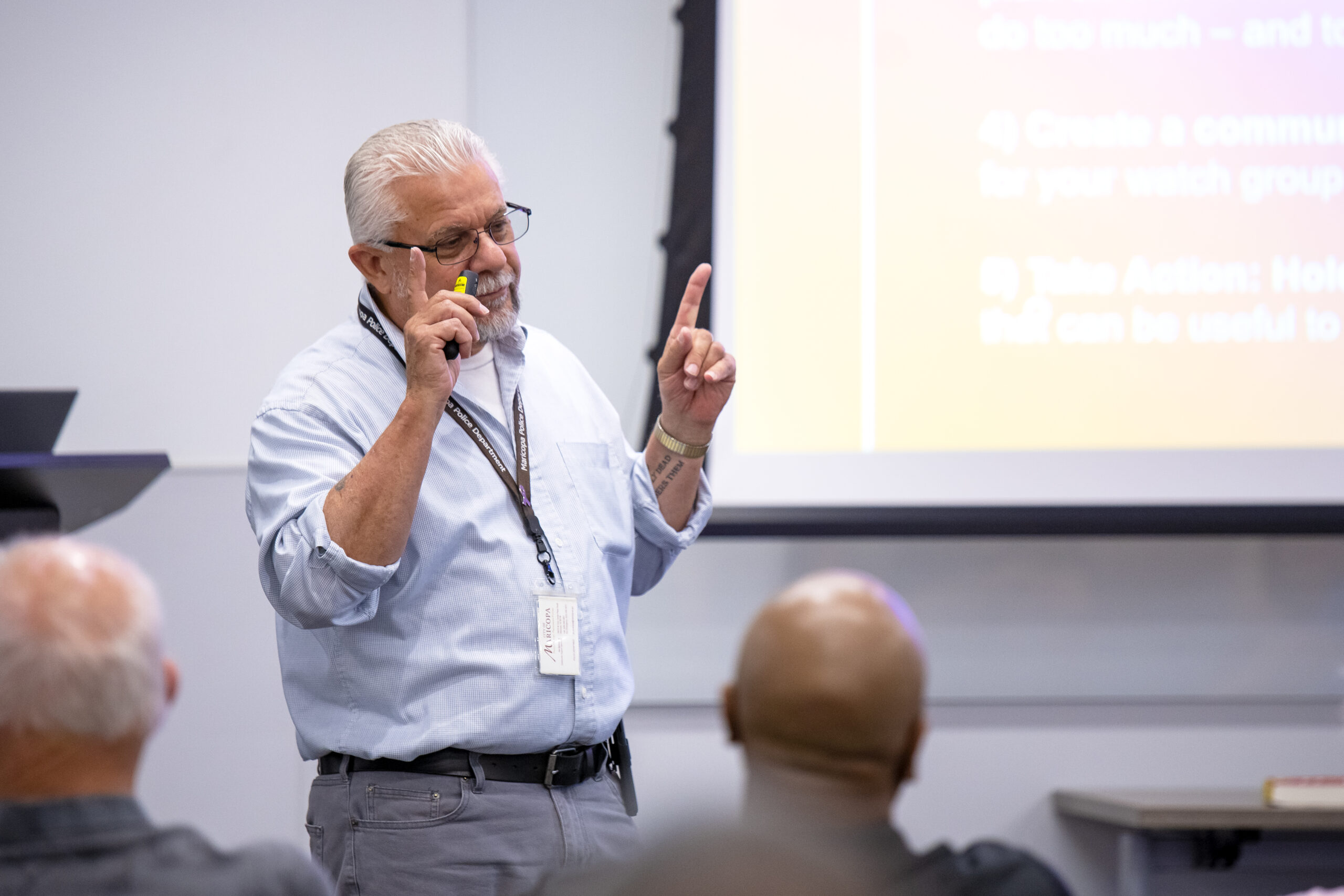
It starts with going across the street to talk to your neighbor about, ‘Hey, I’m going out of town,’ or ‘I saw your garage door open yesterday,’” he said. “That starts the conversation of, ‘Hey, let’s watch out for one another.’ And if people did that section by section, then it would form a safety net.”
In May, MPD hosted an informational meeting for residents interested in starting their own neighborhood watch programs. The session came in the wake of a particularly violent spate of a dozen shootings, including a murder and at least three attempted murders. DeVenezia said the meeting also served as a timely refresher for residents, since the last neighborhood watch update had been in 2023.

“With some of the latest activities, some of the shootings in particular, it was suggested to me to do a neighborhood watch update,” he said. “If we’re reactive to crime, people hide in fear. But being proactive means having the notion that, ‘We live here, this is my house, this is my block.’ We want people to be proactive.”
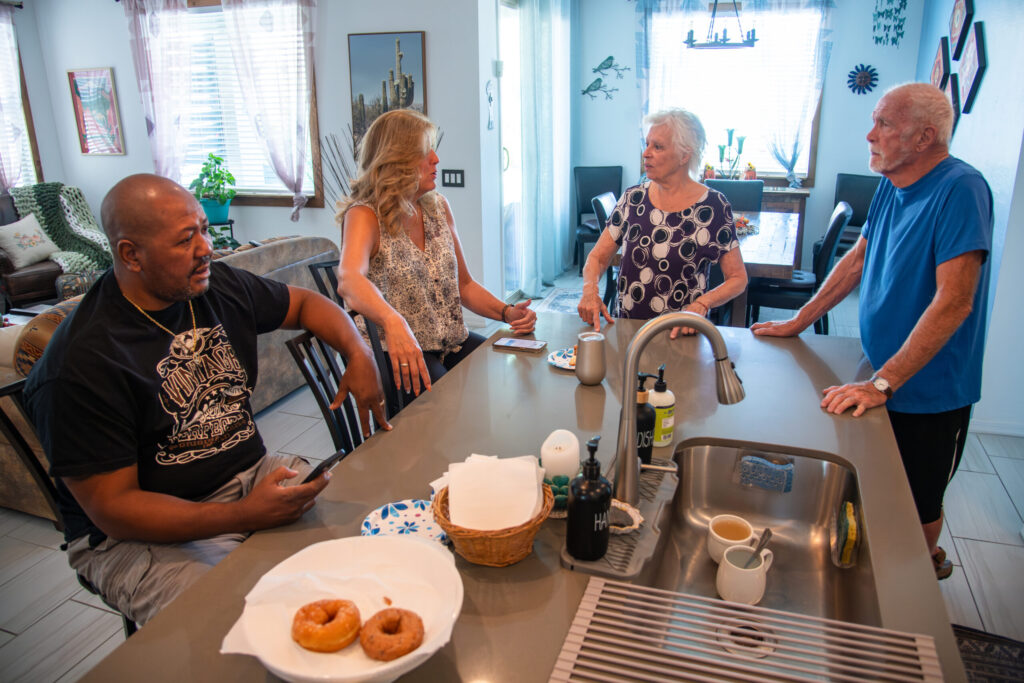
That’s something Tortosa resident Suzanne Juitt agreed with. She’s part of a four-person team operating a small watch group in the southeastern corner of their subdivision.
“We’re not being Karens and we’re not being nosy neighbors. We’re being the neighbors that care,” she said. “Because you don’t know what’s going on in this house or that house.”
‘Grassroots approach’
The official Neighborhood Watch program began in the 1960s as a simple way for neighbors to keep an eye on each other and support local police.
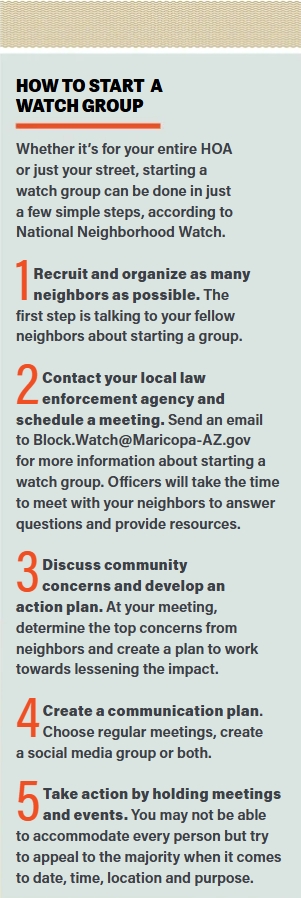
In Maricopa, though, that idea has evolved. The city’s sprawling neighborhoods and fast-growing developments have encouraged a more flexible approach. Most groups operate as small, informal pockets scattered across the city.
Instead of structured, police-run programs, residents rely on a mix of phone chains and social media to stay informed.
DeVenezia said the secret is to start small.
“It just starts with one person and their neighbors,” he said. “You get your first follower, and then it grows naturally. That grassroots approach is what really works.”
He likened it to a YouTube video he’s seen — one showing a man dancing alone at a festival until others join him.
“The first follower is the spark that makes the fire,” the video commentator says.
DeVenezia smiled. “You get your first follower, and then it grows naturally. That grassroots approach is what really works.”
A success story
That’s exactly how a small but active neighborhood watch group in Tortosa came to life.
When Larry Juitt and his neighbor Ted Lynch started the group, their goal was simple. “We just wanted a place to report crime and post safety notes for our community,” Juitt said.
Juitt had helped run a neighborhood watch back in Tacoma, Wash., so he knew the benefits of year-round safety awareness. For Lynch, the motivation was more social.
“We were just tired of waving at people and not knowing their names,” Lynch said.
The group began with just a few streets in the subdivision’s southeastern corner. A photo from that first meeting shows the two couples and one other neighbor in attendance.
Two years and one Facebook page later, the group maintains a modest but steady presence. Despite not seeing much crime — watchers say their most notable case was a 2023 porch pirate with the stolen package being returned shortly after — the group remains active.
When asked what it takes to run the group, Lynch shrugged. “It doesn’t take much.”
Today, a neighborhood watch sign greets drivers at the entrance. A group of women walk the streets most mornings, waving to neighbors and keeping an eye out for anything unusual.
The group’s Facebook page now has more than 100 members. Lynch said they plan to keep growing engagement by hosting another neighborhood meeting and throwing a block party in the coming months.
“The goal now is to remind people we’re still around,” Lynch said. “If they have a problem, we can help them out. And if you’re a problem, then you’ll have to deal with the proper authorities.”
Technology as a tool
Technology has been a godsend for neighborhood watch groups. Gone are the days of peeking out the window like Gladys Kravitz from Bewitched.
“Social media has really helped expand awareness,” DeVenezia said. “It might be less formal than face-to-face meetings, but it’s effective.”
Platforms like Facebook, Nextdoor, Citizen and Ring have replaced phone chains with instant alerts and real-time communication.
“If something happens, like graffiti, we hear about it in 15 or 20 minutes,” added Lynch, from the Tortosa group. “We’re not trying to police the neighborhood — just stay aware and support each other.”
Law enforcement’s take
MPD does not monitor the results of neighborhood watch groups, nor does it keep a tally of how many exist in the city or where. But Goodman called them “an important part of community safety in cities like Maricopa.”
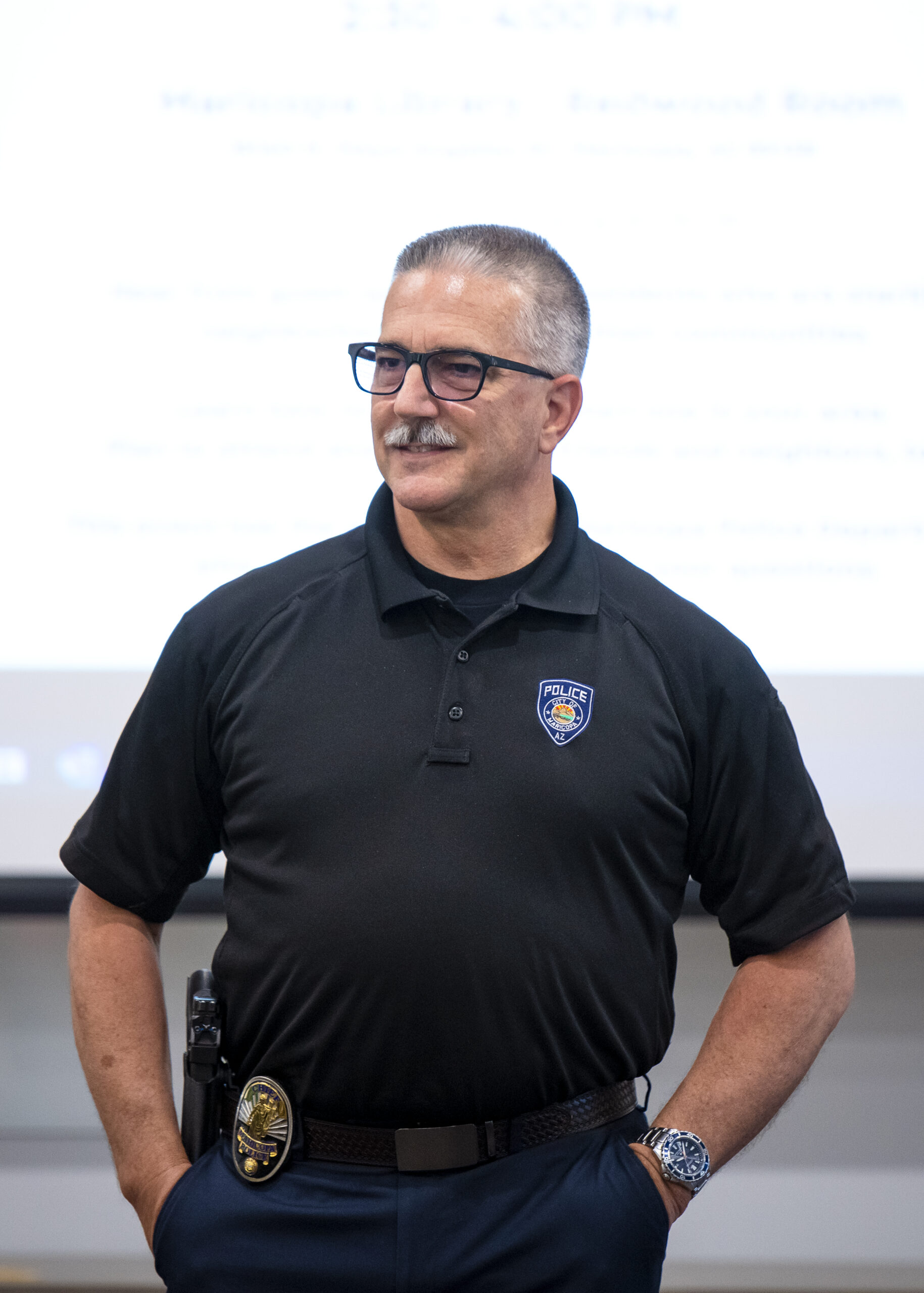
Beyond safety, Goodman said programs like these build trust between residents and police.
“Every neighborhood that is organized and connected through a watch program adds another layer of safety, resilience and durability to our city,” he said.
Not all neighborhoods created equal
When retired Seattle police officer Katie Graves moved to her hillside home in Thunderbird Farms five years ago, the last thing she expected was a string of thefts and break-ins across the neighborhood’s multi-acre ranching properties.
“A year or two after moving here, we started having regular burglaries,” she said. “And me being a former cop — and others knowing that — I kind of got involved.”
Trailer thefts became a pattern.
“I’m like, ‘Well, we’ve obviously got a ring,’” Graves said. “That’s when I started the crime watch group.
Because the Pinal County Sheriff’s Office isn’t patrolling the area most of the time, she launched the Hidden Valley and Thunderbird Farms Crime Watch group on Facebook.

“Everybody wants something as long as they don’t have to put effort into it,” Graves said. “And I was like, ‘Dude, I can’t do this by myself.’”
Eventually, her animal rescue work demanded more of her time, and she handed the group off to new administrators. But as the posts drifted from crime reports to unrelated chatter, she felt its focus slipped.
“That muddied up the group’s contents, in my opinion,” she said.
And unlike tight suburban clusters, her rural setting made outreach harder.
“Neighborhoods are easier,” she said. “You can just walk around and leave flyers on doors. Out here, I have to drive if I want to talk to someone.”
A brief history of neighborhood watch
Interest in community vigilance has ebbed and flowed over the decades, but one of the earliest catalysts was the 1964 murder of Kitty Genovese in Queens, New York.
Early news reports in The New York Times claimed dozens of neighbors ignored her cries for help as she was attacked and killed outside her apartment. While the story was later shown to be exaggerated, it forced Americans to think critically about when — and how — to step in if someone is in danger.
As crime rates rose through the 1960s and into the 1970s, communities began looking for structured ways to keep their streets safe.

In 1972, the National Sheriffs’ Association launched the National Neighborhood Watch Program, now called National Neighborhood Watch. Its mission was simple: Residents act as the “eyes and ears” for police, observing suspicious activity and reporting it without taking matters into their own hands.
But looking out for your neighbors hasn’t always been straightforward.
In 2012, George Zimmerman, a neighborhood watch volunteer in Sanford, Fla., shot and killed 17-year-old Trayvon Martin. The incident ignited a national conversation about racial profiling, vigilantism and the limits of citizen patrols.
Research is mixed on whether neighborhood watch programs actually reduce crime. A scholarly 2008 review of 19 U.S. programs found that about half were linked to a 16% to 26% drop in crime, while the other half showed no measurable effect.
Experts agree, however, that neighborhood watch works best when residents maintain regular contact with police and follow one simple rule: Observe and report.
Today, the National Neighborhood Watch emphasizes the safest communities are those where people stay alert, communicate with one another and let law enforcement handle enforcement.






![Western Pinal Justice of the Peace Patricia Glover speaks during a City of Maricopa Republican Club on May 23, 2026. [Monica D. Spencer]](https://inmaricopa.com/wp-content/uploads/2026/05/20260529-spencer-teeple-republican-club-1-4-300x200.jpg)