

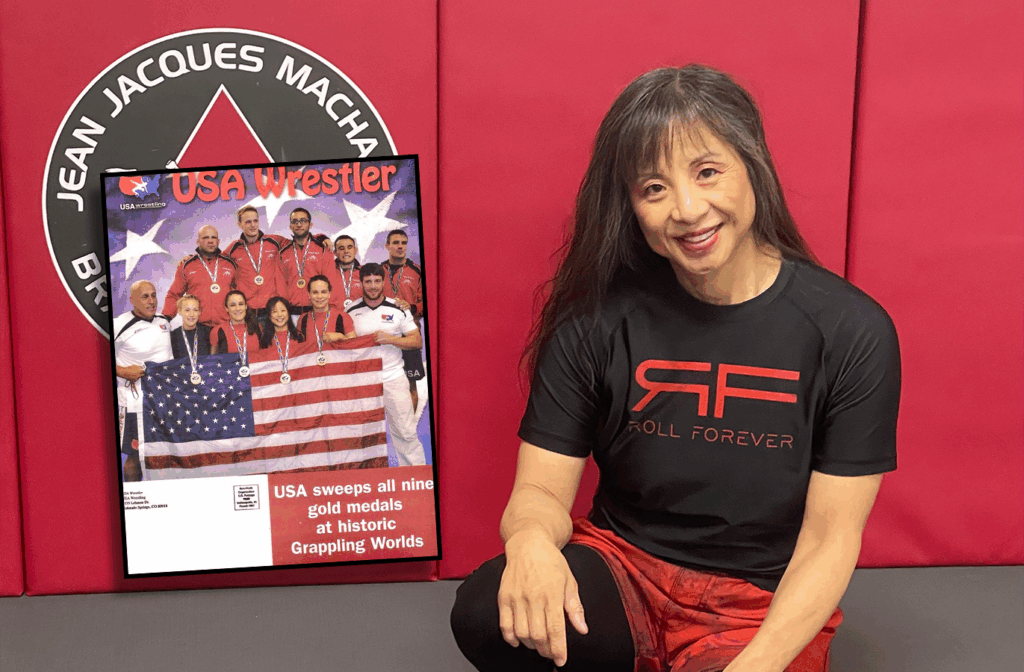
California storms spoiled a pair of major events for then-33-year-old multi-sport athlete Felicia Oh in 2000. That’s when the Maricopan moved her endeavors indoors and became an unlikely champion in Brazilian jiu-jitsu.
Today, the Province resident continues her career outside the ring.
“It took me 33 years to find the sport that made sense for my brain and my body,” she said, adding she was a gymnast prior to hurting her back and dropping the sport at age 15. “I was not very good at it, but I was committed to it.
“When I look back, that taught me how to work hard and be focused. I was doing it for the love of doing it. Those things always carry over to some part of your life.”
A Seattle native, Oh earned a master’s degree in fine arts from UCLA. She started her career in the computer field, leading to work in broadcast graphic design and eventually helping start the digital media department at the Otis College of Art and Design in Los Angeles in 1997.
Three years later, however, she would return to the “arts” — the mixed martial version.
A new option

But she knew none of that at the turn of the century. She entered the Los Angeles Marathon because she wanted a medal that said 2000 on it, but a “nightmare storm” engulfed that event. Later in the year, she was rock climbing with a friend when a spot opened to join a group slated to climb California’s Mount Whitney, the tallest mountain in the contiguous U.S.
On the long drive to northern California, her friend’s husband “mentioned this sport he did called Brazilian jiu-jitsu. He was very excited about it. He said it was fighting but no kicking or hitting. At the time, I only understood fighting as karate or boxing.”
In the hotel the night before the climb, the man began to show Oh the positions used in BJJ. The next day, poorly planned execution by the guides and more storms led to a sleepless night and the thought that “I can’t get off this mountain fast enough.”
Added Oh: “I was thinking, ‘I’m not so good with outdoor sports, so what’s this sport he was talking about?’”
After watching one class, she was hooked on BJJ and signed up the next day. Ignoring the fact she was the only woman in the room, “I started learning. I just kept showing up and getting beat up.”
Her involvement started as a two-days-a-week hobby. She competed in her first tournament after six months, finishing second, and added a day of training to her weekly routine. Another successful tourney and “it just sort of took over my life. I slowly kept adding days, then twice a day and three times a day. I was always pushing and expecting more.”
Oh earned her black belt in less than five years — a process that often takes twice that long.
About six years into her career — after snagging the black belt, winning several titles and finishing second in the prestigious Abu Dhabi Combat Club world championships (considered “the Olympics of grappling”) — she admitted saying to herself, “I’m not too bad at this.”
Battling the best
Tournaments are based on belt level or size and weight categories. Some also include open classes where all the black belts, for example, regardless of size compete against one another. Gi Brazilian jiu-jitsu is when both combatants wear cotton kimonos they can grip to help submit or control each other. Traditional BJJ involves wearing rash-guards and boardshorts, which cannot be grabbed during a match.
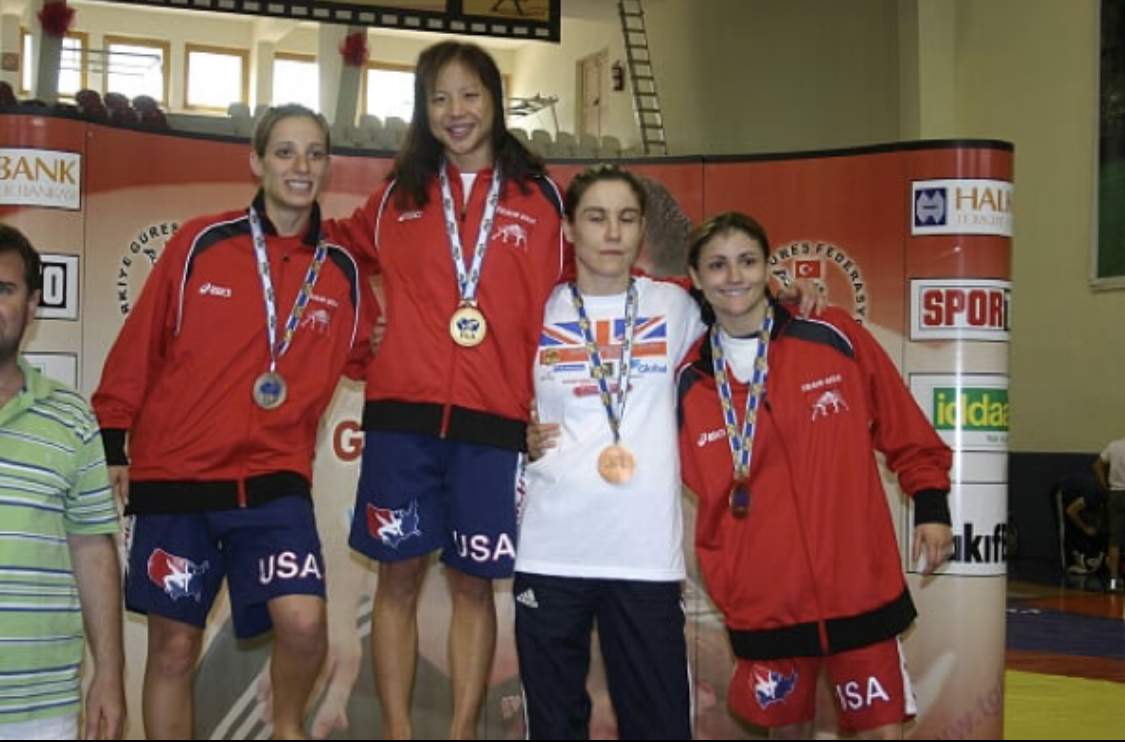
Oh, listed at 5-foot-1 and 115 pounds, was a more deliberate competitor.
“I was of the school that whatever presents itself, I will try to capitalize on,” she confided. “In training, it was always wanting to get better and learn faster. All those things you’re trying and doing and making mistakes, that’s giving you data and information on what not to do.”
Oh didn’t limit her involvement in the sport to competition. BJJ introduced her to other forms of mixed martial arts. As early as 2002, she started interviewing MMA fighters. That led to new journalistic opportunities, including a podcast on Grapple TV that featured conversations at events with both BJJ and MMA competitors.
“Before jiu-jitsu, I thought cage fighting was crazy,” she declared. “But then I understood it’s a sport and not a match to the death. It evolved into a very specialized hybrid of three or four different sports.”
Oh, a Masters Hall of Fame inductee in Ohio, continued her career coaching BJJ, MMA and wrestling.
“I never wanted to be a teacher, but it seemed like whatever I did I ended up teaching.”
Comparing competing to coaching, Oh conceded, “It’s two different experiences. In some senses, it’s much harder coaching. It’s like playing a video game and the controller is not connected. I’m more nervous watching friends or students; you can’t control anything. Competing is a whole different set of stress and nerves, but you are in control in a different way.”
That part of her career came full circle in a way. She coached a wrestler who earned a D-I scholarship to CSU-Bakersfield and is now a high school coach. One of his athletes was a student of Oh’s when he was just 6 years old.

New challenges
Next on Oh’s career path was a role as an inspector with the California State Athletic Commission. The agency regulates boxing, kickboxing and MMA in the Golden State. Oh compared the role to a “fight cop,” ensuring rules are followed and there is an equal playing field for all competitors.
Part of her role was to make sure fighters were prepared. One example was ensuring they were warmed up on time, “because if it was a show on TV, they were not going to wait for you.”
After seven years as an inspector, Oh became a professional MMA judge. That continued her string of unexpected moves and required a shift in her approach.
“I was a judge in 2002 at a blue belt event [at a California casino] and a riot broke out. They shut down the show and sequestered us in a back room,” she recalled. “That was so much trauma that I said I would never judge again. Twenty years and one month later, I’m sitting in a judging course again.”
Judges, like referees in other sports, are typically anonymous “until people are not happy with what you do, and everyone hates you. It’s kind of a thankless job.”
Oh and other judges must be fair and impartial. Or, in her words, adjusting her relationships with people she knows to be more professional. Many people, she said, don’t understand the criteria involved in judging a fight.
“Ultimately, in a fight, it’s about damage. You want to end the fight. You don’t want to just hold the [opponent] down. There’s something inherent about punching and hurting someone rather than taking them down and holding them.”
Oh works mostly in California but is also licensed in Arizona and has judged events at the Wild Horse Pass Hotel & Casino in Chandler.
Asked for her takeaways from the last 24 years in BJJ and related sports, Oh said she is grateful.
“In the big picture, life is insane and incredible. I learned to be open to opportunities, to step up and say yes when they present themselves,” she said. “Sometimes I pinch myself because of the things I get to do and the people I get to meet. I’ve had so many incredible opportunities. It’s important to try things — if you don’t like it, you don’t have to do it.”
As for what’s next, it’s an open canvas.
“I’m not a good architect or planner. I just look one or two steps ahead, kind of like I did in jiu-jitsu.”








![Western Pinal Justice of the Peace Patricia Glover speaks during a City of Maricopa Republican Club on May 23, 2026. [Monica D. Spencer]](https://inmaricopa.com/wp-content/uploads/2026/05/20260529-spencer-teeple-republican-club-1-4-300x200.jpg)