



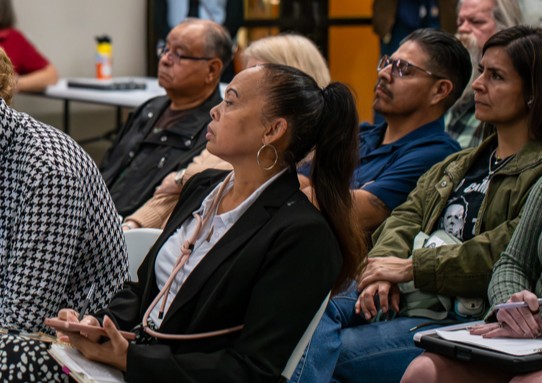
At the Province Candidate Crawl, residents asked the same question in different words. They want to know how decisions get made. They want transparency. They want their voices heard — not after the fact, but in the process.
Maricopa is growing. The question isn’t whether growth will happen — it’s growing for WHO. That question extends to every area of city governance, from public safety to housing development, education investment to economic policy.
After last night’s candidate forum, one thing became absolutely clear: our community isn’t asking for less government or weaker institutions. They’re asking for honest ones. They want to understand the thinking behind major decisions. They want real participation in shaping their city’s future. They want accountability and transparency woven into how we govern.
This is exactly what a Civilian Use of Force Review Panel represents — and it’s a model we should extend across city governance.
What is a CUFRP? It’s not a tribunal or court. It’s a structured, independent review body designed to increase transparency and community understanding when critical incidents occur. It includes community representatives, relevant city staff, and subject matter experts who explain the laws, policies, and decision-making processes involved. The panel reviews incidents, discusses impact, and recommends policy improvements — not individual punishment.
But here’s the bigger idea: Why limit this approach to one issue? Why not apply the same principles — transparency, community voice, structured dialogue, policy improvement — to other major city decisions?
Imagine the same framework applied to housing development decisions. Community members, city planners, developers, and experts sitting together to discuss: How are we building? Who benefits? What’s the impact? What can we learn? The same goes for education investments, economic development incentives, budget allocations, and infrastructure decisions.
That’s not micromanaging. That’s governance that works for everyone.
Right now, too many major decisions happen in council meetings where residents watch but don’t truly engage — at least not before the decision is already made. Public comment comes after the fact. By then, the real work of understanding, questioning, and negotiating has already happened behind closed doors or in staff meetings most people don’t know about.
This isn’t a criticism of any one person or department. It’s a structural challenge. How do we build systems where transparency and community voice are built in from the beginning, not added on as an afterthought?
The CUFRP model shows us how. It says: When something important happens, sit down with the people affected. Explain what happened and why. Listen to their concerns. Discuss what you learned. Improve your policies based on that dialogue. Do this openly. Do it regularly. Do it before you have a crisis on your hands.
The rent you pay on earth is service to community. That applies to everyone — city leaders, department heads, staff, and residents. Service means listening, explaining, and being willing to learn together.
Maricopa is at a moment where we can be intentional about building trust before we need it. We can create systems where transparency isn’t something residents have to fight for — it’s how we naturally operate. We can show that accountability and good governance aren’t opposites — they’re partners.
I encourage city leaders and our department heads to explore how this framework — structured community review, transparent dialogue, policy improvement — could strengthen how we make decisions across city government. I encourage residents to ask for this at the ballot box and in community meetings. And I encourage all of us to remember that we’re building this city together. The decisions we make now shape who gets to stay, who prospers, and what kind of community Maricopa becomes.
Maricopa is growing. Let’s grow intentionally. Let’s grow transparently. And let’s grow for everyone.
Chrystal O’Jon
Candidate for Maricopa City Council





![Global Water Resources told customers in a Friday letter its proposed Maricopa rate hike has been reduced to about 7%, with any new rates unlikely to take effect before 2027. [InMaricopa file]](https://inmaricopa.com/wp-content/uploads/2026/02/Global-Water-180622-_RMC1562-300x200.jpg)
![Five candidates are vying for two seats on Maricopa Unified School District's Governing Board. From left, Loraine Conley, Patti Coutre, Lisa Garcia, Latrinda Williams and Nicolas Yendrzeski. [InMaricopa file]](https://inmaricopa.com/wp-content/uploads/2026/10/20261007-musd-board-candidates-300x200.jpg)
![Amir Badgett and Davontae Lewis were arrested on suspicion of shoplifting at Walmart on Oct. 1, 2026. [Pinal County Sheriff's Office]](https://inmaricopa.com/wp-content/uploads/2026/10/20261007-pcso-badgett-lewis-arrest-300x170.jpg)




4 Responses
He’s not a conservative so who cares about her liberal agenda
Please elaborate on what her “liberal agenda” is exactly.
Or are you just yelling into the wind about your undying loyalty to a party which is just so so sad?
Slayer!!! It’s been a minute!
What’s new, you racist twat???
You still pulling all-nighters, smokin’ meth and jerkin’ off to Nick Fuentes podcasts???
I believe the council meetings are public and that tje agenda if available ahead of time.