
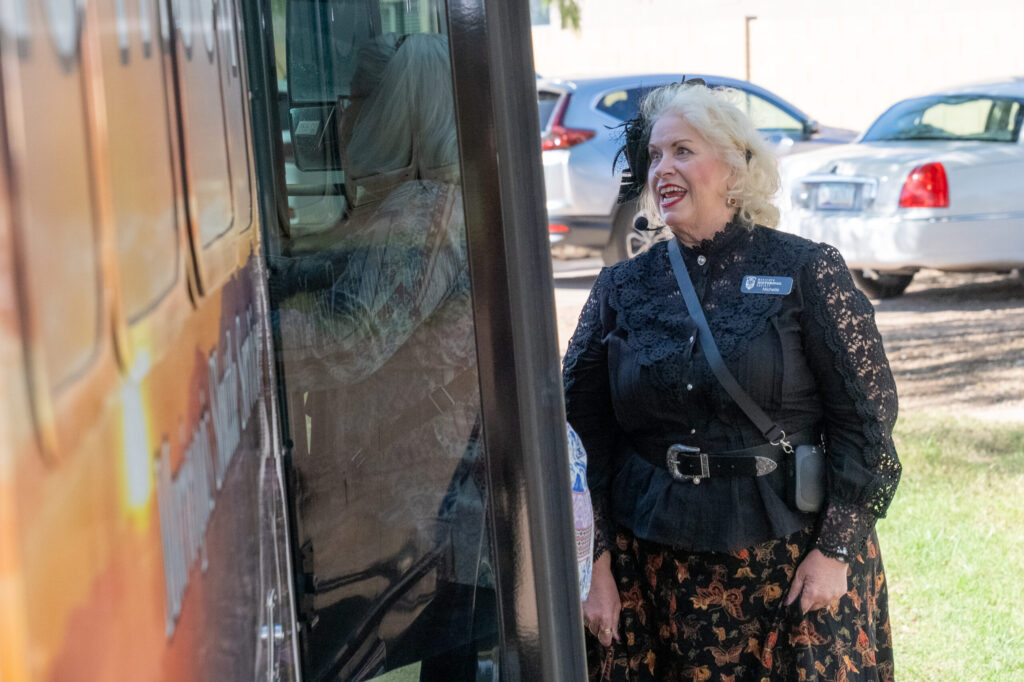
The first bus rumbled away from the Maricopa Museum and Visitor Center just after 1 p.m. The day was warm and bright, with the sun jutting through billowy clouds that looked like cotton.
As part of the city’s Stagecoach Days celebration, members of the Maricopa Historical Society filled tour buses from Ride 347 to carry residents past the old bones of Maricopa: cotton gins, bunkhouses and gas stations reborn as roadhouses, celebrating a time when this place was called Maricopaville, little more than a railroad stop on a long stretch of desert before it was part of America.
The tour came to its marquee stop at the Smith House, a 1950s farmhouse tucked in the middle of a master-planned subdivision called The Villages. Tickets for today’s history lesson cost $5. Seats filled up just days after the tours were announced.
“It was the best $5 I ever spent,” said Karen Nye, climbing back on the bus at the end of the tour. “I’ve lived here just a few years, but I’d never been down half these roads. I finally feel like I found the heart of the place.”

Inside the Smith House, once the center of a 500-acre cotton and pecan farm, the scent of old wood mingled with the sound of history lessons. Longtime Maricopa farmer Oliver Anderson played the role of storyteller for the day, guiding visitors through the “cotton room,” where he demonstrated how a gin separates fiber from seed.
“Back in 1951, cotton was king,” he said, gripping a handful of the fluffy crop. “There was a gin on every corner. Cotton paid the bills.”
He fed a puff of cotton into a small, hand-cranked gin and turned the handle slowly.
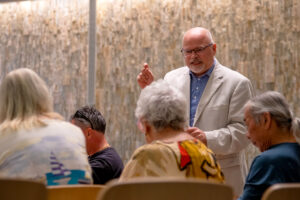
“This machine works the same as when Eli Whitney first made it,” he explained to the crowd that filled the Smith office. “The seed gets cut off with a saw. You can sell it once it’s ginned. You can’t sell it before. That’s what made towns like Maricopa.”
He held up the finished fiber. It was soft, pale and more familiar cloud consistency.
“This is short-staple cotton,” he explained. “Levi’s likes this stuff. Makes the jeans tough. But if you’ve ever bought a towel that won’t dry you off, it’s probably because it’s too long and too thin.”
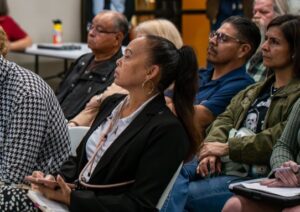
Visitors laughed as they massaged the cotton tufts between their fingers.
“Feel that,” one said. “It’s softer than I expected. It feels like my dog would chew this.”
![Vintage cowboy equipment hangs on a brick wall inside the Smith House, one of the stops on Maricopa’s $5 history tour, Oct. 22, 2025. [David Iversen]](https://inmaricopa.com/wp-content/uploads/2025/10/DSC08970-scaled.jpg)
“In the old days, we didn’t waste a thing,” said Anderson, whose son went on to be Maricopa’s first Mayor. “Cotton was money, plain and simple. Between 1948 and ‘49, there was a gin on every corner in Maricopa.”
Anderson, who moved to Maricopa in 1954, recalled when there were “no paved roads, no phone service and 25-cycle electricity that made your lights blink.”
“We were rural, no question about it. Maricopa changed fast. Sometimes too fast,” he said to the crowd.
The Smiths’ home, built in 1955 for little more than $1 per hour in labor, once farmed cotton and later pecans.
The Smiths refused to move when developers built The Villages at Rancho El Dorado around their home decades later. When patriarch John Smith died last year, his kids decided to gift the property to the city.
“They wanted it to stay what it always was: a gathering place,” said Brenda Campbell, one of the tour organizers.
![Volunteer Robin Holland smiles inside the Cotton Room at the Smith House while showing visitors replica First Lady gowns made from Arizona cotton, Oct. 22, 2025. [David Iversen]](https://inmaricopa.com/wp-content/uploads/2025/10/DSC08986-scaled.jpg)
In another room in the Smith house, volunteer Robin Holland showed visitors a rack of replica First Lady gowns, all made from Arizona cotton.
“These are the cotton ones,” Holland said, smiling. “Not every original was, but because this is the Cotton Room, we chose to display them here.”
At the Smith House, visitors signed a guest book in the old living room, its hand-carved doorframes and stain-glassed windows gleaming in the afternoon light.
When the tour came to an end back at the museum, the history buffs climbed off the bus, their heads full of stories from the past. Campbell pressed a Stagecoach Days token into each hand, a keepsake linking their new home to the history that built it.
![Tour organizer Brenda Campbell walks across the Smith property as visitors explore the grounds during Maricopa’s $5 history tour, Oct. 22, 2025. [David Iversen]](https://inmaricopa.com/wp-content/uploads/2025/10/DSC09004-scaled.jpg)