

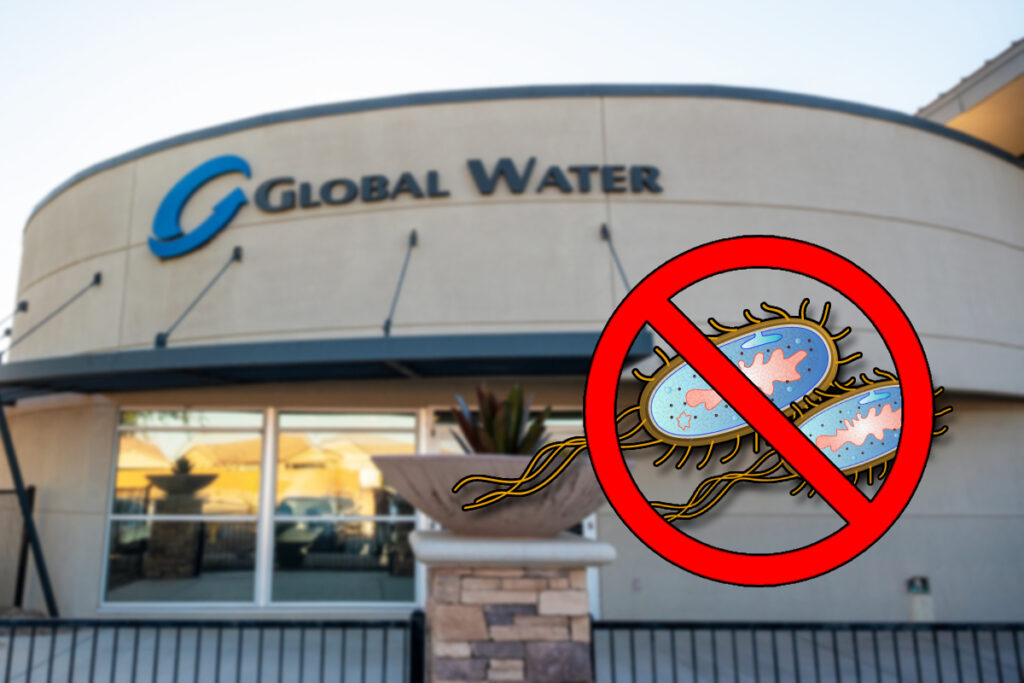
It seems Global Water Resources may have learned their lesson.
Compared to last year, the utility service took a different approach to a possible E. coli contamination Wednesday by alerting residents of a precautionary boil water advisory before they sent for secondary testing.
This isn’t standard protocol, and Maricopa residents have to thank.
The Arizona Department of Environmental Quality requires that the agency be notified in the instance of possible E. coli contamination, but the public is not notified until following confirmation samples whether or not the water supply is contaminated with the bacteria.
“It’s a fact that this could happen in any water system, so we work hard to avoid it. We’ve implemented additional measures since last year, and I’m sure we’ll do more after this incident to make sure that we don’t have this happen again,” said Special Projects Manager Joanne Ellsworth told InMaricopa Thursday.
Last year, Global Water received backlash for following ADEQ’s protocol, which meant alerting residents of the negative test for E. coli three days after they received initial results.
Despite the negative test, many Maricopa residents still felt like more transparency was needed.
Global Water Vice President and General Manager Jon Corwin said at the time the utility would review ways to shorten testing times and improve communication with the public.
“We are taking a step back and saying for the next time, ‘Is there something we can do differently?’ And we’re going to figure that out and do additional research on our end,” Corwin said in September 2025. “We’re looking for those opportunities for improvement.”
What changed?
After the 2025 E. coli scare, Global Water said they underwent a “Level 2 assessment” with ADEQ. The process involved making sure the well-sites were secure, clean, and free of rainwater and surface water at a well-site.
Operators also increased their maintenance checks to make sure that drainage is draining away versus toward well-sites.
Global Water’s response timeline
Oct. 7: Global Water received preliminary positive test results from routine water sampling between noon and 1 p.m. The utility activated its Emergency Operations Center and decided by 2 p.m. to issue a voluntary precautionary boil water advisory.
Global Water collected repeat samples and delivered them to a third-party laboratory by 4 p.m. The utility posted the advisory around 5 p.m. and notified the city, media and customers.
Oct. 8: Global Water continued assessing its water system and distributed a customer update at noon.
Repeat test results received at 2 p.m. came back negative for E. coli and total coliform. Global Water canceled the precautionary advisory and notified the city and media. Customer emails and alerts began going out around 3 p.m.
What happens if E. coli is detected?
According to ADEQ regulations, they must be notified within a 24-hour period at the first indication of E. coli, or any contaminant near a well site.
The water company then has to engage in “repeat sample testing,” which involves taking at least five samples at the well in question.
Because Global Water had two positive tests after re-testing at the origin site, they opted to double-test sources both upstream and downstream for a total of six tests.
They sent the tests to a third-party laboratory for testing. The results in September 2025 and this year both came back negative.
How could E. coli contamination happen?
Contamination can occur if a water source has a break in a main line, or if low pressure occurs and sucks in debris and surface water.
Global Water said they hadn’t experienced a main break or low pressure.
There are also false positives that can happen if the sample is exposed to droplets blowing in the air near a farm or, in some cases, in the days following heavy storms.
Avoiding contamination
Visual inspections are important to ensure that everything is working properly. It’s important to make sure there aren’t holes in the pumps, obvious damage and that the water is draining away from the site, according to Ellsworth.
“We understand why this would be inconvenient and why people would be upset, but we want people to be safe and we want our drinking water to be safe,” Ellsworth said.



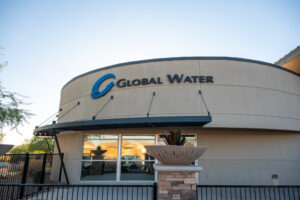


![Global Water Resources told customers in a Friday letter its proposed Maricopa rate hike has been reduced to about 7%, with any new rates unlikely to take effect before 2027. [InMaricopa file]](https://inmaricopa.com/wp-content/uploads/2026/02/Global-Water-180622-_RMC1562-300x200.jpg)
![Five candidates are vying for two seats on Maricopa Unified School District's Governing Board. From left, Loraine Conley, Patti Coutre, Lisa Garcia, Latrinda Williams and Nicolas Yendrzeski. [InMaricopa file]](https://inmaricopa.com/wp-content/uploads/2026/10/20261007-musd-board-candidates-300x200.jpg)
![Amir Badgett and Davontae Lewis were arrested on suspicion of shoplifting at Walmart on Oct. 1, 2026. [Pinal County Sheriff's Office]](https://inmaricopa.com/wp-content/uploads/2026/10/20261007-pcso-badgett-lewis-arrest-300x170.jpg)